How do you change a business name with the IRS?
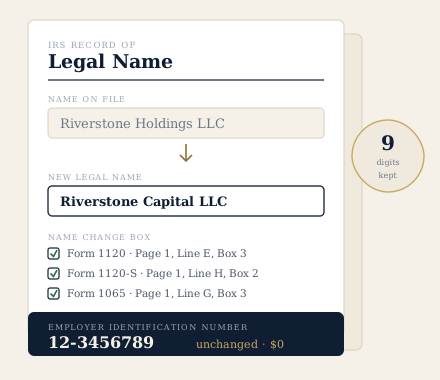
You change a business name with the IRS through 5 routes: the name change box on Form 1120, Form 1120-S, or Form 1065, or a signed letter to the IRS address where you filed. Each costs $0.
Route 1: Check the name change box on Form 1120
A corporation reports a new legal name on page 1, Line E, Box 3 of Form 1120. The IRS reads the box and the new name printed in the same block.
The route costs $0 and adds 1 checkbox to a return the corporation already files.
Route 2: Check the name change box on Form 1120-S
An S corporation reports a new legal name on page 1, Line H, Box 2 of Form 1120-S. The box sits in the header block above the income lines.
The box number differs from Form 1120, which is the single most common filing error on this change.
Route 3: Check the name change box on Form 1065
A partnership reports a new legal name on page 1, Line G, Box 3 of Form 1065. Multi-member LLCs taxed as partnerships use the same box.
The return carries the change for the whole entity, so no separate letter is filed alongside it.
Route 4: Write to the IRS address where you filed your return
A sole proprietor reports a new business name in a signed letter mailed to the IRS address where the return was filed. No IRS form exists for this route.
The letter is the only route for a sole proprietor, because Schedule C carries no name change box.
Route 5: Write to the IRS after the return is already filed
An entity that already filed this year's return reports the new name in a signed letter to the IRS address where that return was filed.
The checkbox works once per return, so a change made after filing waits for a letter or the next return.
Source: IRS, Business name change, verified July 2026.
Which route applies to your entity type?
The route follows the return you file. A corporation uses Form 1120, an S corporation uses Form 1120-S, a partnership uses Form 1065, and a sole proprietor writes a letter. An LLC follows its tax classification.
An LLC is the case that confuses people, because the IRS records no entity called an LLC. The IRS sees a disregarded entity, a partnership, or a corporation, and the name change route follows that classification. A single-member LLC filing Schedule C writes the letter that a sole proprietor writes.
| Entity | Form | Exact box | Who signs |
|---|---|---|---|
| C corporation | Form 1120 | Page 1, Line E, Box 3 | A corporate officer |
| S corporation | Form 1120-S | Page 1, Line H, Box 2 | A corporate officer |
| Partnership | Form 1065 | Page 1, Line G, Box 3 | A partner |
| Multi-member LLC | Form 1065 | Page 1, Line G, Box 3 | A partner or member |
| LLC taxed as a C corp | Form 1120 | Page 1, Line E, Box 3 | A corporate officer |
| LLC taxed as an S corp | Form 1120-S | Page 1, Line H, Box 2 | A corporate officer |
| Single-member LLC | None, a signed letter | No box exists | The owner |
| Sole proprietorship | None, a signed letter | No box exists | The owner |
Source: IRS, Business name change, verified July 2026.
Read 8 of those rows carefully and 1 pattern appears: 6 entities check a box and 2 write a letter. The dividing line is whether the entity files its own federal return. A disregarded entity reports on the owner’s Form 1040, and that return carries no name change box for the business.
What goes in the IRS business name change letter?
The letter carries 7 elements: the old legal name, the new legal name, the 9-digit EIN, the business address, the date of the change, a statement requesting the update, and a wet signature from an authorized person.
No IRS form governs this letter, so its contents are the whole of its accuracy. The IRS matches the letter to an account using the EIN and the old legal name. A letter that omits either 1 of those 2 fields cannot be matched to any account.
| Element | Why the IRS needs it | Required |
|---|---|---|
| Old legal name | Locates the account the IRS holds today | Yes |
| New legal name | Becomes the name of record after posting | Yes |
| 9-digit EIN | The primary key on every IRS business account | Yes |
| Business mailing address | Routes the confirmation back to you | Yes |
| Date the name changed | Sets the period the new name applies to | Yes |
| A clear request to update the record | States the action, so the letter is not filed as correspondence | Yes |
| Signature of an authorized person | Proves authority, which the IRS verifies before posting | Yes |
| State amendment or filed articles | Corroborates the new legal name | Recommended |
Source: IRS, Business name change, verified July 2026.
Mail the letter to the IRS address where you filed your last return. The IRS names no central address for a name change, and it names no fax line for one either, which is why the return address on your own filed return is the instruction that matters.
Send the letter in a way that produces a delivery record. The IRS assigns no tracking number to a name change letter, so the mailing receipt is the only proof that the request left your hands on a given date.
What do you do when the return is already filed?
You write to the IRS at the address where that return was filed. A corporate officer signs for a corporation, and a partner signs for a partnership. The name change box works once per return.
Two paths remain after a return is filed. The first is the signed letter, which updates the record inside the current year. The second is the name change box on next year’s return, which updates the record with that filing.
Choose the letter when anything else depends on the new name. A bank account, a payroll registration, and a marketplace verification each check the IRS record, and waiting up to 12 months for the next return stalls all 3.
The name changed before the return was filed. Check the name change box on that return and print the new legal name in the name block. One filing does both jobs, at $0.
The name changed after the return was filed. Mail a signed letter to the IRS address where that return was filed. The 7 elements listed above make the letter matchable to your account.
The entity files no return of its own. A sole proprietorship and a single-member LLC report on Form 1040, so the letter is the only route. No name change box exists on Schedule C.
Does Form 8822-B change a business name?
No. Form 8822-B changes 3 things: the mailing address, the business location, and the responsible party. Line 4a records the current legal name for identification only, so the form never renames an entity.
Line 4a is the reason for the confusion. It sits at the top of the form under the heading business name, and it reads like a field you overwrite. It is not. The IRS uses line 4a with line 4b, the 9-digit EIN, to locate the account that the 3 checkboxes above act on.
Filing Form 8822-B with a new name in line 4a produces a mismatch rather than a change. The IRS holds the old name, the form presents a new one, and the account lookup fails. Read the field-by-field walkthrough on the form 8822-b page before filing it for anything.
| What changed | Correct instrument | Deadline | IRS fee |
|---|---|---|---|
| Legal business name | Return name change box or a signed letter | None published | $0 |
| Mailing address | Form 8822-B, lines 5 and 6 | None published | $0 |
| Business location | Form 8822-B, line 7 | None published | $0 |
| Responsible party | Form 8822-B, lines 8 and 9 | 60 days | $0 |
| The legal entity itself | Form SS-4, a new EIN | Before the first filing | $0 |
Sources: IRS Form 8822-B, IRS Business name change, and Regulations section 301.6109-1(d)(2)(ii) for the 60-day rule. Verified July 2026.
What happens to your name control after a name change?
The 4-character name control changes with the legal name. The IRS derives it from the first 4 characters of the name of record, so a new name produces new characters. The 9-digit EIN never changes.
A name control is the reason a name change has a consequence at all. The IRS stores 4 characters beside every EIN and matches that pair on every e-filed return. Riverstone Holdings LLC controls to RIVE. Change the name to Vantage Holdings LLC and the control becomes VANT.
Between the name change and the moment the IRS posts it, 2 records disagree. Your software transmits the new 4 characters, the IRS holds the old 4, and the return rejects. Filing under the old legal name until the change posts avoids the rejection entirely.
Only 38 characters are valid inside a name control: the 26 letters, the 10 digits, the hyphen, and the ampersand. A rebrand that introduces a period or an apostrophe drops that character from the control, which changes the 4 characters in a way the new name does not show. Work through the derivation rules on the IRS name control page.
How long does an IRS business name change take?
The IRS publishes no processing time for a business name change. A change filed on a return posts when that return posts. A change filed by letter posts when the IRS works the correspondence.
An honest answer beats an invented one here. The IRS states a 60-day reporting deadline for a responsible party change and states no deadline and no processing window for a name change. Any site quoting a fixed number of weeks for this is quoting itself.
Plan around the posting rather than the promise. Two signals confirm the change landed: an IRS notice addressed to the new legal name, and an e-filed return that clears the name control match on the new first 4 characters. Until 1 of those 2 appears, treat the old name as the name of record.
| Change | IRS-published deadline | IRS-published processing time |
|---|---|---|
| Business name change | None | None |
| Responsible party change | 60 days | None |
| Business address change | None | None |
| New EIN by IRS online tool | None | 15 minutes |
Source: IRS published guidance, verified July 2026.
Does changing your name with the state update the IRS?
No. A state and the IRS keep 2 separate records. An amendment filed with the Secretary of State changes the state record only. The IRS learns the new legal name from the return box or the signed letter.
The order matters. The state amendment creates the new legal name, and the IRS notice reports a name that already exists in law. Telling the IRS first reports a name the state has not yet recognised, which leaves the IRS record ahead of the formation record.
Three records end up needing the same name, in this order: the Secretary of State, the IRS, and then the bank. A bank verifies the IRS pairing against a CP-575 or a 147C, so the bank is always last. Read what the confirmation letter proves on the CP-575 page.
Does a DBA or trade name need an IRS name change?
No. The IRS records 1 legal name per EIN, and a DBA is a trade name registered with a state or a county. Adding a DBA changes no IRS record and requires no letter.
A DBA and a legal name serve different systems. The DBA lets a business trade under a public brand. The legal name is what the IRS matches against the EIN. One entity runs any number of DBAs and still holds 1 legal name and 1 EIN.
The practical consequence sits on Form W-9. Line 1 takes the legal name that matches the EIN, and line 2 takes the DBA. Reversing those 2 lines produces the name control mismatch that generates a B-notice from the payer.
What do you update after the IRS record changes?
Six records carry the old name after the IRS posts the change: the bank account, Form W-9 with clients, payroll filings, state tax accounts, licences, and the CP-575 in your files, which never reprints.
The CP-575 is the one record that cannot be corrected. The IRS issues 1 CP-575 per EIN and never reprints it, so the letter keeps the original name forever. A 147C letter is what prints the current pairing after a name change posts.
| Record | What it needs | Proof it accepts |
|---|---|---|
| Business bank account | The new legal name on the account | A 147C letter or the state amendment |
| Form W-9 held by clients | A fresh W-9, line 1 updated | Your signature on the new form |
| Payroll filings and W-2s | The new name in the employer block | The posted IRS record |
| State tax accounts | A separate state name update | The state amendment |
| Licences and permits | A renewal or an amendment | Varies by issuing authority |
| CP-575 letter in your files | Nothing, it never reprints | A 147C letter replaces it |
Source: IRS documents and standard bank verification practice, verified July 2026.
Request the replacement letter once the change posts, not before. A 147C issued before the IRS updates the record prints the old name and proves the wrong thing. The request procedure sits on the 147C letter page, and the document anatomy sits on the EIN confirmation letter page.
A business winding down rather than renaming follows the opposite procedure. The IRS closes an account on a written request, which the cancel ein page sets out line by line.
When does a change require a new EIN instead?
When the legal entity changes rather than its name. A sole proprietorship that incorporates needs a new EIN. A single-member LLC that adds a member becomes a partnership and needs one. The IRS charges $0.
A rename keeps the entity and swaps the label. A conversion ends 1 entity and starts another, and the new entity holds no EIN until it applies. Reading the difference wrongly is the error that sends a renamed business chasing a number it already owns, and a converted business filing under a number that belongs to a closed entity.
Work the full matrix of changes that keep the number against those that do not on the do I need a new EIN page.
Applying without a Social Security Number
Form SS-4 line 7b accepts the word Foreign, so the IRS issues EINs to responsible parties who hold no SSN and no ITIN. The application moves from the online tool to fax. The IRS fax line is 855-641-6935 for entities based in a US state and 855-215-1627 for international applicants. The IRS international phone line is 267-941-1099. No identity document is filed with Form SS-4.
Have an SSN? irs.gov is free, and the online tool issues the EIN in 15 minutes.
| Filed by | Price | Accuracy guarantee | Year 2+ |
|---|---|---|---|
| Yourself, direct to the IRS | $0 | Not stated | $0 |
| ein-number.com, Standard | $69 | Accuracy, 2–3 weeks total | $0 |
| ein-number.com, Fast | $99 | Accuracy, filed within 24 hours | $0 |
| Northwest | $200 | Not stated | $0 |
| ZenBusiness | $99 | Not stated | $0 |
Competitor prices verified July 2026. Northwest reflects the no-SSN rate. Business days are Monday to Friday, excluding US federal holidays.
The IRS charges $0 for an EIN through every method. The $69 covers preparation, a senior error review, IRS fax filing within 8 business days, IRS monitoring across 4 tracked stages, and the EIN in 2–3 weeks. The $99 Fast tier files within 24 hours, adds the IRS phone call, and lands in 7 business days. You can get your EIN number from $69 or file it yourself for nothing.
Which primary sources back this page?
Every fee, deadline, form number and phone line above is taken from the 3 official documents below. No third-party blog is cited.