Does a sole proprietorship need an EIN?
An EIN for a sole proprietorship is required in 4 IRS situations: employees, excise returns, a retirement plan, and bankruptcy. A sole proprietor outside those 4 reports under a Social Security Number, and the IRS fee is $0.
The rule follows from one fact. A sole proprietorship has no legal existence apart from its owner, so the IRS already holds a taxpayer record for the business under the owner’s Social Security Number. Profit lands on Schedule C, self-employment tax lands on Schedule SE, and both attach to the same Form 1040. Nothing in that chain needs a second number.
An EIN becomes necessary at the moment the business takes on an obligation the IRS tracks in its own account: payroll, excise, a pension plan, or a bankruptcy estate. Each of those produces returns that the owner’s personal record cannot carry, because they file on their own cycle and under their own deadlines.
Outside those 4 triggers the number stays optional and stays useful. A business bank account, a payment platform, a marketplace seller review, and a Form W-9 signed for a client each accept an EIN in place of an SSN. The difference between the two numbers is set out on the ein vs ssn page. Two trades hand the number out often enough that the choice stops being theoretical: a childcare provider furnishes it to every parent claiming the credit, covered on the EIN for a daycare page, and a marketplace seller enters it in a tax interview, covered on the EIN for Amazon sellers page.
What changes when a sole proprietor starts paying other people?
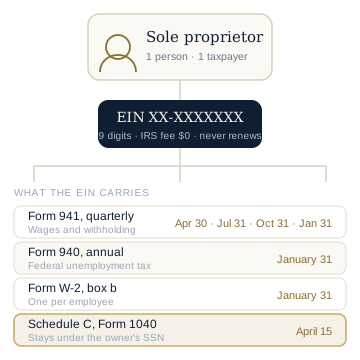
The EIN becomes a filing account. Form 941 falls due 4 times a year, Form 940 once, and every Form W-2 and Form 1099-NEC by January 31. All of them print the 9-digit EIN.
The first hire converts a once-a-year personal filing into a recurring employment tax account. That account is identified by the EIN on every return and every deposit, which is the mechanical reason the IRS requires the number before wages are paid rather than after.
| Form | What it reports | Deadline | Number printed |
|---|---|---|---|
| Form 941, quarter 1 | Wages and withholding, January to March | April 30 | EIN |
| Form 941, quarter 2 | Wages and withholding, April to June | July 31 | EIN |
| Form 941, quarter 3 | Wages and withholding, July to September | October 31 | EIN |
| Form 941, quarter 4 | Wages and withholding, October to December | January 31 | EIN |
| Form 940 | Federal unemployment tax for the full year | January 31 | EIN |
| Form W-2 | Wages paid to each employee | January 31 | EIN in box b |
| Form 1099-NEC | Payments made to a contractor | January 31 | EIN in the payer block |
| Schedule C | Business profit or loss | April 15 | The owner's SSN |
Source: IRS form instructions, verified July 2026.
Read the last row against the 7 above it. Schedule C keeps reporting under the Social Security Number after the EIN issues, because the profit belongs to the owner personally. A sole proprietor with staff therefore runs 2 live identifiers at once, and putting the wrong one on a return is the single most common filing error in this entity type.
Which tax rates does a sole proprietor’s EIN carry?
Self-employment tax runs at 15.3%, made up of 12.4% for Social Security and 2.9% for Medicare, once net earnings reach $400. Employment tax on wages runs at 7.65% for the employer and 7.65% for the employee.
Those two columns never merge. Self-employment tax is the owner’s own liability and reports on Schedule SE under the Social Security Number. Employment tax is the business’s liability for other people’s wages and reports on Form 941 under the EIN.
| Tax | Rate | Base | Form | Number |
|---|---|---|---|---|
| Self-employment tax | 15.3% | Net earnings from $400 | Schedule SE | SSN |
| Social Security portion | 12.4% | Net earnings | Schedule SE | SSN |
| Medicare portion | 2.9% | Net earnings | Schedule SE | SSN |
| Employer share of FICA | 7.65% | Employee wages | Form 941 | EIN |
| Federal unemployment tax | 6.0% | First $7,000 per employee | Form 940 | EIN |
| Same tax, after the full state credit | 0.6% | First $7,000 per employee | Form 940 | EIN |
Source: IRS Schedule SE, Form 941 and Form 940 instructions, verified July 2026.
The federal unemployment credit is worth reading twice. The gross rate is 6.0% on the first $7,000 of each employee’s wages, and a state unemployment credit of up to 5.4% brings the federal cost to 0.6% on that same $7,000. Both figures print on Form 940 against the EIN.
Holding an EIN changes 0 of these rates. The number routes the filings; it does not price them.
Why do banks ask a sole proprietor for an EIN and a CP-575?
A bank verifies the 9-digit EIN against the legal name printed on the IRS CP-575 letter. The IRS issues 1 CP-575 per EIN and never reprints it, so the replacement document is a 147C letter.
The check is a name match, not a number check. The IRS builds a name control from the first 4 characters of the legal name it holds, and a sole proprietorship fails that match more than any other entity type, because the storefront name and the owner’s legal name are different strings.
That is what line 1 and line 2 of Form SS-4 are for. Line 1 carries the owner’s legal name and becomes the name control. Line 2 carries the DBA and becomes the name the bank prints on the account. An application that reverses them produces a CP-575 the bank cannot reconcile, and the account stalls at verification.
The anatomy of the letter is set out on the cp 575 page, and the full document family sits on the ein confirmation letter page.
Which Form SS-4 lines does a sole proprietor fill differently?
Line 1 takes the owner’s own legal name, not the trade name. Line 2 takes the DBA. Line 9a takes the sole proprietor box, and line 7b takes an SSN, an ITIN, or the word Foreign.
Ten lines decide whether the CP-575 comes back usable. The 4 that carry the most weight are 1, 2, 9a, and 13, because each one writes a permanent attribute into the IRS record rather than a fact the IRS can later correct on its own.
| Line | What it asks | Sole proprietor entry | The error it causes |
|---|---|---|---|
| Line 1 | Legal name of the entity | The owner's own legal name, character for character | A trade name here creates an IRS record no bank matches to the owner |
| Line 2 | Trade name or DBA | The registered DBA, when one exists | A blank line 2 leaves the storefront name off the CP-575 |
| Line 4a and 4b | Mailing address | The address that receives the CP-575 letter | A wrong address loses the only copy of the letter the IRS prints |
| Line 7a | Name of the responsible party | The owner, in every sole proprietorship | A bookkeeper here hands IRS authority to the wrong person |
| Line 7b | Responsible party SSN, ITIN, or EIN | The SSN, the ITIN, or the word Foreign | A blank line 7b returns the application unprocessed |
| Line 8a | Is this application for an LLC | No, for a sole proprietorship | Yes here routes the record to an entity that does not exist |
| Line 9a | Type of entity | The sole proprietor box | A wrong box fixes the wrong return series to the number for life |
| Line 10 | Reason for applying | Started a new business, hired employees, or banking purpose | A blank reason returns the application unprocessed |
| Line 13 | Employees expected in the next 12 months | The real count, or 0 | A count above 0 opens a Form 941 filing requirement immediately |
| Line 16 | Principal activity | The actual trade the business carries on | A vague entry sends the application to manual review |
Source: IRS Form SS-4 and its instructions, verified July 2026.
Line 13 deserves its own note. Entering a number above 0 tells the IRS to expect Form 941 from the quarter wages begin, and the filing requirement opens whether or not anyone is hired. A sole proprietor applying only for a bank account enters 0 and selects banking purpose on line 10.
The route-by-route procedure sits on the how to apply for an ein page, and the delivery times for each route sit on the how long does it take to get an ein page.
How many EINs does one sole proprietor hold?
One. A sole proprietor holds 1 EIN across every business and every DBA they operate, because the IRS assigns the number to the person named on line 1. Three storefronts share the same 9 digits.
A DBA is a state or county registration of a trading name. It creates no taxpayer, so it receives no federal number. A person running a bakery, a consultancy, and an online shop as sole proprietorships files 3 Schedule C forms and holds 1 EIN.
Four changes that look significant need 0 new applications: renaming the business, moving to another state, adding a second location, and registering another DBA. Form 8822-B records an address change, and the same form records a change of responsible party within 60 days of the change.
The line-by-line walkthrough of that form sits on the form 8822-b page.
Do spouses running a business together need one EIN or two?
A qualified joint venture files 2 Schedule C forms and 2 Schedule SE forms, one per spouse, and needs 0 EINs while there are no employees. Employees add 1 EIN, held by 1 spouse.
The election is open to a married couple who jointly own an unincorporated business, both materially participate in it, and file a joint return. Each spouse reports their share of income and deductions on their own Schedule C, which is what gives each of them Social Security and Medicare credit for the work.
Without that election the same facts describe a partnership, and a partnership is a separate taxpayer that files Form 1065 and needs its own EIN. The difference between 0 new EINs and 1 new EIN is the election, not the business.
Once the couple hires, employment tax returns file under a single EIN belonging to one spouse. The IRS does not split a payroll account across 2 people, so 1 spouse holds the number and files every Form 941 and Form 940 under it.
How does a sole proprietor without an SSN get an EIN?
Form SS-4 line 7b accepts the word Foreign, so the IRS issues the EIN with no SSN and no ITIN. The route moves from the online tool to fax: 855-641-6935, or 855-215-1627 for an international applicant.
The online tool is the only route that requires an SSN or ITIN, and it is the reason the requirement is so widely misreported. The fax route runs on the same Form SS-4, is processed by the same IRS unit, and returns the same 9-digit number and the same CP-575 letter. No identity document is filed with the form, so no passport is uploaded at any point.
The honest route for your situation
Have an SSN? irs.gov is free, and the online tool issues the number in 15 minutes.
No SSN? The fax route works, also at $0, and the IRS returns the number in 4 business days when the application carries a return fax number. Or we file it from $69, double-checked before submission.
The IRS international line is 267-941-1099 for applicants outside the United States.
The complete no-SSN reference, including what line 7b does to the rest of the record, sits on the ein without ssn page.
When does a sole proprietor need a new EIN?
Four events create a new taxpayer: incorporating, taking on a partner, filing Chapter 7 or Chapter 11 bankruptcy, and inheriting or buying a business you then run as a sole proprietorship. Other changes need 0 new applications.
| Change | New EIN | What to file instead |
|---|---|---|
| Change the business name | No | Form 8822-B, or a name-change notice with the annual return |
| Move to another state | No | Form 8822-B for the new address |
| Add a second location | No | Nothing federal |
| Register another DBA | No | County or state registration only |
| Hire the first employee, EIN already held | No | Form 941 from the quarter wages start |
| Incorporate | Yes | A new Form SS-4 for the corporation |
| Take on a partner | Yes | A new Form SS-4 for the partnership |
| Form a single-member LLC | Yes | A new Form SS-4 for the LLC |
| File Chapter 7 or Chapter 11 | Yes | A new Form SS-4 for the bankruptcy estate |
| Buy or inherit a business and run it yourself | Yes | A new Form SS-4 in your own name |
| The owner dies and an estate continues | Yes | A new Form SS-4 for the estate |
Source: IRS guidance on responsible parties and new EIN requirements, verified July 2026.
Read the Yes rows as a single test. Each one creates a taxpayer that did not exist the day before, and a taxpayer with no history needs its own account. The No rows describe the same taxpayer wearing a different name, address, or storefront, which the IRS updates rather than replaces.
The full entity-change matrix sits on the do i need a new ein page, and the classification questions that follow an LLC formation sit on the ein for llc page.
What happens to a sole proprietorship EIN when the business closes?
The IRS never cancels an EIN and never reassigns the 9 digits. It closes the business account behind them after a letter sent to Internal Revenue Service, Cincinnati, OH 45999. The fee is $0.
An EIN is permanent by design. The number stays attached to the owner it was issued to, which is why a sole proprietor who closes one business and starts another later reuses the same 9 digits rather than applying again.
Closing the account is a sequence of final returns. A final Form 941 goes in with the final-return box checked, a final Form 940 follows by January 31, each employee receives a Form W-2 by January 31, and a final Schedule C reports the last year of profit or loss under the owner’s Social Security Number.
The 4 items the closure letter has to carry are listed on the cancel ein page.
How much does an EIN for a sole proprietorship cost?
The IRS charges $0 through every route, in year 1 and every year after, because an EIN never renews. ein-number.com charges $69 at Standard speed, 2–3 weeks total, or $99 at Fast speed, 7 business days total.
| Filed by | Price | Total turnaround | Year 2 and after |
|---|---|---|---|
| Yourself, direct to the IRS | $0 | 4 business days by fax | $0 |
| ein-number.com, Standard | $69 | 2–3 weeks | $0 |
| ein-number.com, Fast | $99 | 7 business days | $0 |
| Northwest | $200 | Not stated | $0 |
| ZenBusiness | $99 | Not stated | $0 |
| Rocket Lawyer | $59.99 | Not stated | $0 |
Competitor prices verified July 2026. Northwest reflects the no-SSN rate. Business days are Monday to Friday, excluding US federal holidays.
The number itself is free on all 4 IRS routes, and it stays free forever, because an EIN carries no renewal and no expiry. The $69 Standard tier buys preparation with senior error review, IRS fax filing within 8 business days, 4 tracked stages from received to delivered, and the EIN by email, 2–3 weeks total. The $99 Fast tier files within 24 hours, adds the IRS phone follow-up, and runs 7 business days total. Every filing is double-checked before submission, and if we make an error, full refund, no conditions.
A cost breakdown by route and entity type sits on the how much does an ein cost page. To file for your sole proprietorship now, get started.
Which primary sources back this page?
Every fee, deadline, form number and phone line above is taken from the 3 official documents below. No third-party blog is cited.