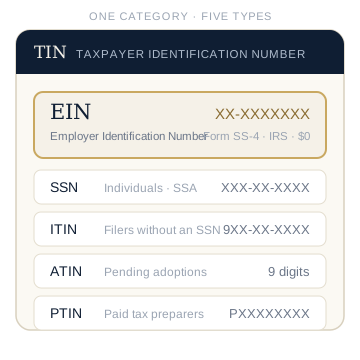
What are the 5 types of TIN?
The 5 TIN types are the SSN, the EIN, the ITIN, the ATIN, and the PTIN. The Social Security Administration issues 1 of them. The IRS issues the other 4. Each one identifies a different kind of taxpayer.
Read each type by the question it answers: who is being identified. That single test separates all 5 without any tax knowledge. An entity, a citizen, a foreign individual, an adopted child, and a paid preparer are 5 different subjects, so the IRS built 5 different numbers.
EIN: Employer Identification Number
The EIN identifies the entity, not a person. A corporation, a partnership, an LLC, a trust, an estate, and a nonprofit each hold one. The EIN survives an address change, a name change, and an owner change, because it belongs to the entity behind the name.
SSN: Social Security Number
The SSN is the only TIN the IRS does not issue. The Social Security Administration issues it on Form SS-5. A sole proprietor with no employees reports business income under an SSN and holds no EIN at all.
ITIN: Individual Taxpayer Identification Number
The ITIN exists for individuals who carry a US filing obligation and no SSN eligibility. It identifies a person on a personal return. It grants no work authorization and no Social Security benefit, and it never substitutes for an EIN on a business return.
ATIN: Adoption Taxpayer Identification Number
The ATIN is temporary. The IRS issues it for a child placed in a pending domestic adoption whose SSN has not issued yet, so the adoptive parents claim the child on a return. The SSN replaces it once the adoption finalizes.
PTIN: Preparer Tax Identification Number
The PTIN identifies the preparer who signs a return for compensation, not the taxpayer. It is the one TIN that starts with a letter, and the only one carrying a yearly renewal. No business ever files under a PTIN.
Source: IRS, verified July 2026.
How do you tell an EIN from another TIN by its format?
Count the digits before the first separator. An EIN prints 2 digits, a hyphen, then 7. An SSN, an ITIN, and an ATIN print 3 digits, then 2, then 4. A PTIN starts with the letter P.
The 2-7 split is the fastest identification on any document. Four of the 5 types hold exactly 9 digits, so length alone settles nothing. Grouping settles it in 1 second.
| Number | Digit grouping | Total characters | Distinguishing mark |
|---|---|---|---|
| EIN | 2 then 7 | 9 digits | A single hyphen after the 2nd digit |
| SSN | 3 then 2 then 4 | 9 digits | Two hyphens, first digit is not 9 |
| ITIN | 3 then 2 then 4 | 9 digits | Always begins with 9 |
| ATIN | 3 then 2 then 4 | 9 digits | Begins with 9, issued for a child |
| PTIN | P then 8 | 9 characters | The only type starting with a letter |
Source: IRS, verified July 2026.
The 9 prefix does more work than it looks. Every ITIN opens with 9, and the IRS restricts the 4th and 5th digits to the ranges 50 to 65, 70 to 88, 90 to 92, and 94 to 99. A 9-digit number opening with 9 in one of those ranges is an ITIN, never an SSN. An EIN opens with a 2-digit prefix instead, which carries no meaning about the owner.
Who issues each TIN, and on which form?
The IRS issues 4 of the 5 TIN types: the EIN on Form SS-4, the ITIN on Form W-7, the ATIN on Form W-7A, and the PTIN on Form W-12. The Social Security Administration issues the SSN on Form SS-5.
One agency split matters in practice. An SSN application goes to the Social Security Administration and depends on immigration status. An EIN application goes to the IRS and depends on nothing about the applicant beyond a valid entity and a named responsible party.
That separation is the reason a founder with no SSN still receives an EIN. The 2 numbers travel through 2 different agencies with 2 different eligibility tests. Line 7b of Form SS-4 accepts the entry Foreign in place of a personal identification number, which closes the loop.
| Number | Agency | Application form | Renews |
|---|---|---|---|
| EIN | IRS | Form SS-4 | Never |
| SSN | Social Security Administration | Form SS-5 | Never |
| ITIN | IRS | Form W-7 | Expires after 3 consecutive unused tax years |
| ATIN | IRS | Form W-7A | Temporary, replaced by the SSN |
| PTIN | IRS | Form W-12 | Every calendar year |
Sources: IRS and Social Security Administration, verified July 2026.
Which TIN does a business use?
A corporation, a partnership, a multi-member LLC, an estate, a trust, and any business with employees use an EIN. A sole proprietor with 0 employees uses an SSN. Entity type decides, not preference.
The rule reads off the entity, not the owner. A single owner holding an SSN still files a corporation under the corporation’s EIN, because the corporation is a separate taxpayer from the person who created it.
| Entity | TIN used on the return | EIN required |
|---|---|---|
| Sole proprietor, 0 employees | SSN, or an EIN by choice | No |
| Sole proprietor with employees | EIN | Yes |
| Single-member LLC, no employees | Owner SSN or the LLC EIN | No, and banks ask for one |
| Multi-member LLC | EIN | Yes |
| Partnership | EIN | Yes |
| C corporation or S corporation | EIN | Yes |
| Estate of a deceased person | EIN | Yes |
| Trust, other than a grantor trust | EIN | Yes |
| Nonprofit or tax-exempt organization | EIN | Yes |
Source: IRS Form SS-4 instructions, verified July 2026.
Nine rows, one pattern: the moment a second person enters the picture, whether a partner or an employee, the EIN becomes mandatory. Payroll reporting on Form 941 and Form W-2 has no field for an owner’s SSN, so the entity number is the only number that fits.
What is the difference between an EIN and an SSN?
An EIN identifies a business entity and an SSN identifies a person. The IRS issues the EIN on Form SS-4. The Social Security Administration issues the SSN on Form SS-5. Both carry 9 digits and cost $0.
The practical difference is exposure. An SSN on a W-9 travels to every client who pays you, and each copy becomes an identity risk. An EIN on the same line reveals a business number instead, which is why many sole proprietors apply for an EIN they are not required to hold.
The 2 numbers also behave differently over time. An SSN follows a person for life. An EIN follows an entity, so it ends when the entity ends and a successor entity applies for its own. Work through the sole proprietor decision on the ein vs ssn page.
What is the difference between an EIN and an ITIN?
An EIN identifies a business entity and an ITIN identifies an individual filer with no SSN eligibility. The IRS issues the EIN on Form SS-4 and the ITIN on Form W-7. Neither one substitutes for the other.
One belief costs founders months: that an ITIN comes first. It does not. Form SS-4 line 7b accepts the entry Foreign for the responsible party, so the IRS issues an EIN with no personal identification number on file. An ITIN application on Form W-7 runs on its own timeline and answers a personal filing obligation, not a business one.
The 2 numbers also differ in lifespan. An EIN never expires and never renews. An ITIN expires after 3 consecutive tax years without use on a return, and renewal restores it. Read the full comparison on the ein vs itin page.
Which TIN goes on Form W-9?
Part I of Form W-9 takes the TIN of the name on line 1. A corporation, a partnership, and a multi-member LLC enter an EIN. A sole proprietor enters an SSN or an EIN. Mismatches trigger 24% backup withholding.
The number and the name must agree. The IRS matches the TIN in Part I against the name on line 1 through a name control derived from the first 4 characters of the legal name. A W-9 carrying an EIN beside a personal name fails that match, and the payer receives a B notice.
Backup withholding is the cost of getting this wrong. The payer withholds 24% of every payment and sends it to the IRS until the record is corrected. Recovering it means claiming the withheld amount on a return, which delays the money by months.
Source: IRS Form W-9 instructions and the 24% backup withholding rate under Internal Revenue Code section 3406. Verified July 2026.
Read the line-by-line detail on the ein on w9 form page.
Is a federal tax ID number the same as an EIN?
Yes, in a business context. Federal tax ID number is the everyday name for the EIN. Both point to the same 9 digits on the same CP-575 letter. On a personal return it means the SSN or the ITIN.
Banks, payment processors, and marketplaces use the 3 labels interchangeably on their forms: EIN, federal tax ID, and business tax ID. Each request wants the same 2-then-7 digit number issued on Form SS-4. Nothing changes about the number when the label changes.
Read the synonym in full on the federal tax id number page, and see where the number appears in your records on the ein number lookup page.
What triggers CP-2100 backup withholding?
Three things. A TIN and name that do not match on the W-9, a missing TIN on a 1099 filing, or a TIN the IRS or SSA reports as invalid. The payer receives CP-2100 or CP-2100A after the 1099 filing, and backup withholding at 24% begins 30 business days after receipt.
The notice goes to the payer, not to you. CP-2100 lists the payee records that failed matching, and the payer is the party the IRS puts under obligation: it must issue you a B-notice and start withholding if you do not correct the pairing. This is the mechanism by which a wrong EIN on a W-9 surfaces months after the fact, long after the form was signed.
Fix it by sending the payer a corrected Form W-9. Check the TIN against the CP-575 for an EIN, or the SSA card for an SSN, and confirm the name on line 1 pairs with the number in the Part I TIN box rather than guessing which the payer wants. Once corrected, withholding stops on the next payment, and amounts already withheld are recovered on the next annual return rather than refunded directly.
The 24% rate comes from IRC section 3406 and has applied since January 1, 2018. It was 28% under the 2001-2017 regime, so older guidance still circulating online quotes the wrong figure.
What does each TIN cost?
The SSN, EIN, ITIN, and ATIN each cost $0 from the government. The PTIN is the 1 exception, carrying a yearly IRS user fee. An EIN never renews, so year 2 and every year after cost $0.
The IRS charges nothing for an EIN through any filing method. A paid service charges for preparation, a second review, and filing, never for the number itself. That distinction is worth holding onto when comparing prices.
| EIN filed by | Price | Total turnaround | Year 2+ |
|---|---|---|---|
| Yourself, direct to the IRS | $0 | Not stated | $0 |
| ein-number.com, Standard | $69 | 2–3 weeks total, filed by fax within 8 business days | $0 |
| ein-number.com, Fast | $99 | 7 business days total, filed within 24 hours | $0 |
| Northwest | $200 | Not stated | $0 |
| ZenBusiness | $99 | Not stated | $0 |
| Rocket Lawyer | $59.99 | Not stated | $0 |
Competitor prices verified July 2026. Northwest reflects the no-SSN rate. Business days are Monday to Friday, excluding US federal holidays.
Why do people mix up an EIN and a TIN?
Five causes explain most of the confusion: a category compared to a member, 4 types sharing 9 digits, 3 interchangeable labels for the EIN, forms that ask for a TIN, and state numbers that resemble a federal one.
A category set against one of its members. EIN vs TIN reads like a choice and describes a hierarchy. The correct question is which of the 5 TIN types applies to the entity in front of you.
Four of the 5 types carry 9 digits. An EIN, an SSN, an ITIN, and an ATIN each hold 9 digits, so length identifies nothing. Only the grouping and the leading character separate them.
The EIN answers to 3 different labels. Federal tax ID number, business tax ID, and employer identification number all name the same 9 digits issued on Form SS-4. Three labels, one number.
Tax forms ask for a TIN, not an EIN. Part I of Form W-9 is headed Taxpayer Identification Number, which is the category. The correct entry is whichever of the 5 types belongs to the name on line 1.
A state tax number resembles a federal one. A state issues its own employer or sales tax registration number, and it is not a TIN. Only the 5 federal types listed here are TINs, and only the IRS and the Social Security Administration issue them.
One more confusion belongs here: the belief that changing a business name changes the EIN. It does not. The EIN belongs to the entity, and the IRS records a new name against the same 9 digits. Record it on the change business name with irs page. A change of entity type is the case that requires a new number, covered on the do i need a new ein page.
A separate number sits outside the TIN family entirely. A D-U-N-S Number is a 9-digit business identifier issued by a private company for credit reporting, not by the IRS, and no tax form accepts it. Read the distinction on the ein vs duns number page.
How do you get the EIN once you know you need it?
File Form SS-4 with the IRS. The IRS charges $0 and delivers the 9-digit EIN with a CP-575 confirmation letter. Line 7b accepts the entry Foreign when the responsible party holds no SSN.
The route splits on one fact, and the honest answer differs for each side.
Have an SSN? irs.gov, free, 15 minutes.
The IRS online tool issues the EIN in the same session at a cost of $0. Paying a service for that is paying for nothing.
No SSN? The fax route, or we file it.
The online tool closes without an SSN or an ITIN, and Form SS-4 goes by fax instead. The IRS fax line is 855-641-6935 for entities based in a US state and 855-215-1627 for international applicants. The IRS international phone line is 267-941-1099. No identity document is filed with Form SS-4, and no passport upload is involved.
Line 7b is the whole mechanism. It asks for the responsible party’s SSN, ITIN, or EIN, and it accepts the word Foreign when none exists. Rejections on that line come from a blank field or a mismatched entity name, not from the absence of a personal number.
The IRS charges $0 for an EIN through every method. The $69 Standard tier covers preparation with a senior error review, fax filing within 8 business days, IRS monitoring across 4 tracked stages, and the EIN by email, 2–3 weeks in total. The $99 Fast tier files within 24 hours with the IRS call included, 7 business days in total. You can use the accuracy-guaranteed EIN filing service or file it yourself for nothing.
Which primary sources back this page?
Every fee, deadline, form number and phone line above is taken from the 4 official documents below. No third-party blog is cited.