Table of contents
- Where does the EIN go on a W-9 form?
- Should you put an EIN or an SSN on a W-9?
- Whose name goes on line 1 when you enter an EIN?
- How does an LLC fill out the W-9 with an EIN?
- What happens when the name and EIN on a W-9 do not match?
- What is backup withholding on a W-9?
- How do you complete a W-9 with an EIN but no SSN?
- Does a foreign person file a W-9 or a W-8?
- What do you do if the W-9 is due before the EIN arrives?
- Does a W-9 expire, and when do you send a new one?
- What does the payer file from your W-9?
- Which number does each entity type enter?
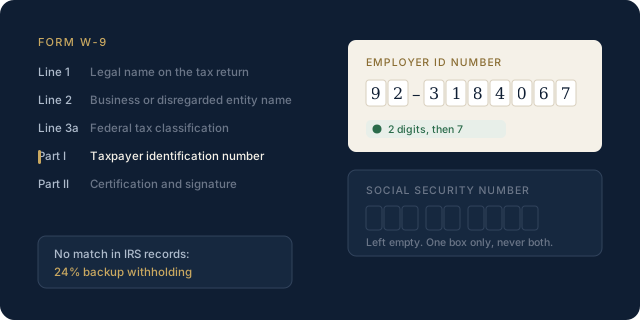
The EIN on a W-9 form goes in Part I, in the box printed as 2 digits, a hyphen, then 7 digits. The Social Security Number box directly above it stays empty. One box is filled, never both. The name on line 1 has to be the name the IRS holds against that 9-digit number, and a mismatch is what starts 24% backup withholding.
Two fields on a W-9 decide whether it works: the name on line 1 and the 9 digits in Part I. This page walks both fields for all 9 filer types, then covers what happens when the pairing fails.
Where does the EIN go on a W-9 form?
In Part I, the Taxpayer Identification Number section. Part I holds two boxes: a Social Security Number box laid out 3-2-4, and an Employer Identification Number box laid out 2-7. Fill one.
The current form is Form W-9, revision March 2024. Part I sits below line 7 and above Part II, the certification block where the signature and date go. Nothing else on the form asks for a tax number, so an EIN written anywhere else is written in the wrong place.
The two boxes have different shapes on purpose. An SSN prints as 3 digits, 2 digits, then 4, for 9 digits total. An EIN prints as 2 digits then 7, also 9 digits total. A number entered as 12-3456789 is an EIN. A number entered as 123-45-6789 is an SSN.
Filling both boxes is the error the IRS instructions call out directly. A payer receiving a W-9 with two numbers has no way to know which one to report against, so the form goes back and the payment cycle restarts.
The signature in Part II certifies 4 numbered statements: that the number entered is correct, that the signer is not subject to backup withholding, that the signer is a US person, and that any FATCA code entered is correct. That certification is what makes the W-9 stronger evidence than a number typed into an email.
Should you put an EIN or an SSN on a W-9?
The number the IRS associates with the name on line 1. A corporation, partnership, or multi-member LLC enters its EIN. A sole proprietor enters the Social Security Number the IRS instructions ask for first.
Entity type decides it, not preference. A W-9 reports one pairing to the payer: a legal name and the 9-digit number filed under it. The payer then prints that exact pairing on a Form 1099-NEC or 1099-MISC, and the IRS matches it against its own records.
A sole proprietor is the case people get wrong. The IRS instructions say to enter your SSN, and permit an EIN instead when you hold one, because line 1 carries your individual name either way. The IRS states a preference for the SSN in that position.
A single-member LLC treated as a disregarded entity enters the owner's number, not the LLC's. When the owner is another business that holds an EIN, that owner's EIN goes in Part I. When the owner is an individual, the individual's SSN goes there.
Every other entity type enters its own EIN, because the IRS holds the entity itself as the taxpayer. That covers C corporations, S corporations, partnerships, trusts, estates, and any LLC that elected corporate or partnership treatment.
Whose name goes on line 1 when you enter an EIN?
The name the IRS holds against that EIN, spelled character for character. Line 1 is required and never left blank. A trade name or DBA belongs on line 2, and only on line 2.
The source document for the correct spelling is the CP-575, the confirmation letter the IRS issues when it assigns an EIN. Whatever that letter prints is the string the IRS matching system holds. A business that lost the CP-575 requests a 147C letter, which reprints the same pairing.
Punctuation counts as characters. An entity written Acme Holdings LLC on the CP-575 and Acme Holdings, L.L.C. on the W-9 has changed 3 characters, and the IRS name control comparison reads the difference.
Line 2 exists for the operating name. A company incorporated as Bayview Trading Company LLC and invoicing as Bayview Supply enters the first on line 1 and the second on line 2. The payer keeps both and reports the first.
Line 3a is the classification checkbox: Individual or sole proprietor, C corporation, S corporation, Partnership, Trust or estate, LLC, or Other. Line 3b, added in the March 2024 revision, is checked by a partnership, trust, or estate that has foreign partners, owners, or beneficiaries.
How does an LLC fill out the W-9 with an EIN?
An LLC checks the LLC box on line 3a and enters one letter for its tax classification: C, S, or P. A disregarded single-member LLC does not check that box and reports under its owner instead.
The single letter is the whole decision. C means the LLC elected C corporation treatment on Form 8832. S means it elected S corporation treatment on Form 2553. P means it is a multi-member LLC taxed as a partnership by default. Those 3 letters cover every classified LLC.
A single-member LLC that made no election is disregarded for federal income tax. The IRS instructions direct it to enter the owner's name on line 1, the LLC's name on line 2, and the owner's tax number in Part I. The LLC's own EIN stays off the W-9 in that case.
That surprises owners who hold an EIN for their LLC and use it for banking and payroll. The EIN is real and the bank account is correct. Federal income tax reporting still runs to the owner, which is the only question the W-9 asks.
A multi-member LLC works the opposite way. It files its own Form 1065, so line 1 carries the LLC's legal name, line 3a carries the LLC box with P, and Part I carries the LLC's own EIN.
What happens when the name and EIN on a W-9 do not match?
The IRS sends the payer a CP2100 or CP2100A notice. The payer then mails a B notice and starts backup withholding at 24% until a corrected W-9 arrives with a matching name and number.
The IRS issues those notices twice a year, listing every payee whose name and TIN failed to match on an information return. The payer has 15 business days from receipt of the notice to send the first B notice to the payee.
A first B notice asks for a corrected W-9. A second B notice within a 3-year window is stricter: it requires the payee to obtain validation from the IRS itself, which for an EIN means a 147C letter, and for an SSN means a Social Security card copy from the SSA.
Payers avoid the whole sequence with the IRS TIN Matching service, which is free through e-Services. Interactive matching returns a result for up to 25 name and TIN pairs at a time. Bulk matching accepts up to 100,000 pairs in one file and returns results within 24 hours.
The failure is almost always the name rather than the digits. A business that changed its legal name and never notified the IRS keeps matching against the old string, which is why a name change and the paperwork behind it belong together.
What is backup withholding on a W-9?
Backup withholding is a flat 24% the payer removes from each payment and sends to the IRS. It starts when a W-9 is missing, unsigned, carries no TIN, or fails an IRS name and number match.
The rate is fixed. It is not a bracket and it is not adjusted for the payee's income, so the payer removes 24% of the gross payment before expenses, deductions, or the payee's actual rate enter the calculation at all.
Four conditions start it: no TIN furnished, a TIN the IRS says is wrong, an IRS notice that the payee underreported interest or dividends, or a failure to certify that the payee is not subject to backup withholding.
The money is not lost. Withheld amounts appear in box 4 of the Form 1099 and credit against the payee's return. Recovering it means waiting for the filing season rather than the next invoice, which is the practical cost.
Two penalties sit alongside it. Failing to furnish a correct TIN to a requester carries a 50 dollar penalty per failure. Making a false statement with no reasonable basis that results in no backup withholding carries a 500 dollar penalty.
How do you complete a W-9 with an EIN but no SSN?
Enter the EIN in Part I and leave the Social Security Number box empty. A W-9 requires exactly one 9-digit number, and an EIN satisfies Part I on its own for any entity the IRS treats as the taxpayer.
This is the ordinary case for a US corporation, partnership, or multi-member LLC. Those entities never hold an SSN, because an SSN belongs to an individual. Part I is complete with the EIN alone, and Part II is signed by a person authorized to sign for the entity.
Getting the EIN itself does not require an SSN either. Form SS-4 line 7b accepts the entry Foreign in place of a Social Security Number or ITIN for the responsible party, which is the line that decides whether an application can proceed.
The online IRS application is the part that requires an SSN or ITIN. Applications without one go by fax or mail instead, and the IRS assigns the same 9-digit number through every route. The number itself is identical whichever door it came through.
The IRS charges 0 dollars for an EIN on every route, and an EIN never renews, so the cost in year 2 and afterwards is also 0 dollars.
Have an SSN? Apply at irs.gov. It costs 0 dollars and takes 15 minutes in one online session, 7 a.m. to 10 p.m. Eastern, Monday to Friday.
No SSN? The fax route works: Form SS-4 with Foreign on line 7b, sent to 855-641-6935 for a US-based entity or 855-215-1627 from outside the United States. Or we file it for you, from $69.
Does a foreign person file a W-9 or a W-8?
A foreign individual files Form W-8BEN and a foreign entity files Form W-8BEN-E. Form W-9 is for US persons only, which includes any entity organised under the laws of a US state.
The test is the entity, not the owner. A Delaware LLC owned entirely by a non-resident is a US person, so the LLC files a W-9 and enters its own EIN when it is classified as a corporation or a partnership.
The disregarded case flips that result. A single-member LLC owned by a foreign individual is disregarded, so federal income tax reporting runs to the foreign owner, and the correct form to give the payer is a W-8BEN in the owner's name rather than a W-9.
A W-8BEN stays valid until the last day of the third calendar year after it is signed, unless a change in circumstances happens first. A form signed in 2026 expires on 31 December 2029.
Line 3b on the March 2024 revision exists for the reverse situation: a US partnership, trust, or estate that has foreign partners, owners, or beneficiaries checks it so the payer knows a look-through applies.
What do you do if the W-9 is due before the EIN arrives?
Write Applied For in Part I, sign, and send the form. The payer accepts it, and the 60-day exemption period lets payments continue while the IRS assigns the number. Send a corrected W-9 the day it arrives.
The exemption is finite. Once the 60-day window closes without a number, the payer starts backup withholding at 24% and holds it until a completed W-9 replaces the placeholder. Filing early is what keeps the window comfortable.
Route decides the wait. The IRS online assistant runs 7 a.m. to 10 p.m. Eastern, Monday to Friday, and issues the number in the same session for an applicant with an SSN or ITIN. The IRS instructions for Form SS-4 state 4 business days for fax with a return fax number, and 4 weeks for mail.
The IRS fax lines are 855-641-6935 for entities based in a US state and 855-215-1627 for international applicants. The IRS international phone line for EIN questions is 267-941-1099.
Filing help is priced differently by each provider, and the IRS fee is the same on every route. Verified July 2026: Northwest charges $200 at its no-SSN rate, ZenBusiness charges $99, and ein-number.com charges $69 at Standard speed or $99 at Fast speed, both carrying the written accuracy guarantee. The IRS charges $0 on every route.
Does a W-9 expire, and when do you send a new one?
A W-9 carries no expiration date and stays valid until the information on it changes. Send a corrected form as soon as the legal name, the tax classification, or the 9-digit number changes.
Four changes trigger a replacement: a legal name change, a change in federal tax classification, a new EIN after a change of entity, and a correction after a B notice. An address change on line 5 also warrants a fresh form so the 1099 arrives.
The payer keeps the signed W-9 on file rather than sending it to the IRS. Record retention for information return support runs 4 years from the due date of the return or the date the tax was paid, whichever is later.
An electing S corporation is the classification change people forget. An LLC that filed Form 2553 changed the letter that belongs in the LLC box on line 3a, and every payer holding the old form is reporting under the old classification.
The 1099-NEC deadline is 31 January for both the recipient copy and the IRS copy, so a correction sent in December costs nothing and the same correction sent in February costs an amended return.
What does the payer file from your W-9?
An information return carrying the exact name and 9-digit number from the form. Form 1099-NEC covers nonemployee compensation of 600 dollars or more in a calendar year. Form 1099-MISC covers rents and other income.
The W-9 is never sent to the IRS. It is the payer's working copy, and its only job is to supply the 2 fields the payer prints on a 1099 in January. Everything the W-9 gets wrong, the 1099 repeats.
The dollar thresholds differ by box. Nonemployee compensation reports at 600 dollars or more on Form 1099-NEC. Rents, prizes, and other income report at 600 dollars or more on Form 1099-MISC. Royalties and broker payments in lieu of dividends report at 10 dollars or more.
The deadlines differ too. Form 1099-NEC is due 31 January for the recipient copy and 31 January for the IRS copy. Form 1099-MISC is due 31 January to the recipient, 28 February to the IRS on paper, and 31 March to the IRS electronically.
Electronic filing became the default at a low count. A payer filing 10 or more information returns of all types combined in one calendar year has to file them electronically, which is why payers now chase a clean W-9 well before January rather than during it.
Source: IRS General Instructions for Certain Information Returns (2026) and the IRS instructions for Forms 1099-MISC and 1099-NEC. Verified July 2026.
Which number does each entity type enter on the W-9?
Nine filer types cover the field. Corporations, partnerships, multi-member LLCs, electing LLCs, trusts, and estates enter their own EIN. Sole proprietors and disregarded single-member LLCs report under the owner. Foreign persons file a W-8 instead.
| Filer | Line 1 name | Line 3a box | Part I number | EIN required |
|---|---|---|---|---|
| C corporation | Corporate legal name | C corporation | Corporation EIN | Yes |
| S corporation | Corporate legal name | S corporation | Corporation EIN | Yes |
| Partnership | Partnership legal name | Partnership | Partnership EIN | Yes |
| Multi-member LLC | LLC legal name | LLC, letter P | LLC EIN | Yes |
| LLC electing C or S | LLC legal name | LLC, letter C or S | LLC EIN | Yes |
| Disregarded single-member LLC | Owner name, LLC on line 2 | Owner classification | Owner SSN or owner EIN | No |
| Sole proprietor | Individual name, DBA on line 2 | Individual or sole proprietor | SSN first, EIN permitted | No |
| Trust or estate | Trust or estate legal name | Trust or estate | Trust or estate EIN | Yes |
| Foreign individual or entity | Not applicable | Not applicable | Files W-8BEN or W-8BEN-E | No W-9 |
Source: IRS Form W-9 and its instructions, revision March 2024. Verified July 2026.
The second table is the consequence table. It answers the question that follows every mismatch: what the payer does next, on what clock, and at what cost.
| Trigger | What the payer does | Clock | Cost to the payee |
|---|---|---|---|
| No W-9 on file | Withholds immediately | From the first payment | 24% of each payment |
| Part I marked Applied For | Accepts and waits | 60-day exemption period | 0 until day 61 |
| Name and EIN do not match | Sends a first B notice | 15 business days from CP2100 | 24% until corrected |
| Second mismatch in 3 years | Sends a second B notice | Requires a 147C letter | 24% until IRS validates |
| No TIN furnished at all | Reports the failure | Per information return | 50 dollar penalty per failure |
| False certification, no basis | Refers the statement | Per false statement | 500 dollar penalty |
Source: IRS Form W-9 instructions and IRS Publication 1281 on backup withholding. Verified July 2026.
What else do people ask about the EIN on a W-9 form?
+Where exactly does the EIN go on a W-9 form?
In Part I, in the Employer Identification Number box, which prints as 2 digits, a hyphen, then 7 digits. The Social Security Number box above it, laid out 3-2-4, stays empty. Exactly one of the two boxes is filled on any W-9, never both at once.
+Can I use an EIN instead of my SSN on a W-9?
Yes for any entity the IRS treats as the taxpayer, including a corporation, a partnership, and a multi-member LLC. A sole proprietor is directed to enter the SSN first, and the IRS permits an EIN in that box instead. Line 1 still carries the individual name.
+What is the backup withholding rate on a W-9?
A flat 24% of each payment, removed by the payer and sent to the IRS. It starts on a missing, unsigned, or unmatched W-9. The withheld amount appears in box 4 of the Form 1099 and credits against the payee's return, so it is deferred rather than lost.
+What name goes on line 1 of the W-9 with an EIN?
The legal name the IRS holds against that 9-digit number, spelled character for character as it appears on the CP-575. A trade name goes on line 2. A 3-character difference such as LLC against L.L.C. is enough to fail the IRS name and number match.
+How does a single-member LLC complete the W-9?
A disregarded single-member LLC enters the owner's name on line 1, the LLC's name on line 2, and the owner's tax number in Part I. Its own EIN stays off the form. An LLC that elected corporate treatment enters its own EIN and one letter, C or S, on line 3a.
+What happens if the EIN on a W-9 does not match IRS records?
The IRS sends the payer a CP2100 or CP2100A notice. The payer has 15 business days to mail a first B notice and starts 24% backup withholding. A second B notice within 3 years requires IRS validation, which for an EIN means a 147C letter.
+Can I fill out a W-9 without an SSN?
Yes. Part I requires exactly one 9-digit number, and an EIN satisfies it. Getting the EIN also works without an SSN, because Form SS-4 line 7b accepts the entry Foreign for the responsible party. The IRS charges 0 dollars for the number on every route.
+What do I write on the W-9 if my EIN has not arrived?
Write Applied For in Part I, sign Part II, and send it. A 60-day exemption period lets payments continue while the IRS assigns the number. After 60 days without a number, the payer starts backup withholding at 24% until a corrected W-9 replaces it.
+Does a W-9 expire?
No. A W-9 carries no expiration date and stays valid until the information changes. Four changes call for a replacement: a legal name change, a classification change, a new EIN, and a correction after a B notice. A foreign person's Form W-8BEN does expire, on 31 December of the third year after signing.
+Do I need a new EIN before I can send a corrected W-9?
Only when the entity itself changed, such as a sole proprietorship incorporating or a single-member LLC adding a partner. A name change or address change keeps the same 9 digits. ein-number.com files a new EIN for $69 at Standard speed, 2–3 weeks total, or $99 at Fast speed, 7 business days total, with every filing double-checked before submission.
This page states IRS procedures and Form W-9 instructions current as of July 2026. It is not legal or tax advice. ein-number.com is not affiliated with the IRS.
Filling in the W-9 and the EIN box is empty?
Applied For buys 60 days. A number ends the clock. The IRS charges $0 on every route, and anyone holding an SSN should use irs.gov and pay nothing. For an applicant without one, we prepare Form SS-4 with Foreign on line 7b, double-check it before submission, track 4 stages, and deliver the 9-digit EIN and the official IRS CP-575. Standard is $69, filed by fax within 8 business days, 2–3 weeks total. Fast is $99, filed within 24 hours with the IRS call included, 7 business days total. If we make an error, full refund, no conditions. Business days are Monday to Friday excluding US federal holidays.
No SSN. No passport upload. · the accuracy-guaranteed EIN filing service, from $69
Primary sources verified against irs.gov on 2026-07-28: IRS_PUBS_VERIFIED = ["1281"]. Direct link: Publication 1281.
Which primary sources back this page?
Every fee, deadline, form number and phone line above is taken from the 3 official documents below. No third-party blog is cited.