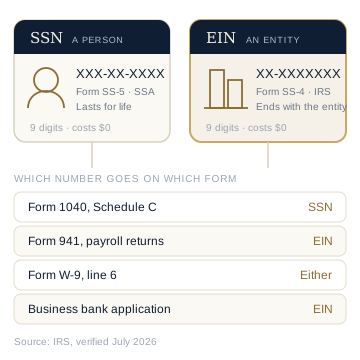
What does each number identify?
An SSN identifies a person and stays with that person for life. An EIN identifies a business entity and ends when the entity ends. Both carry 9 digits, and the IRS treats each as a taxpayer identification number.
That single distinction settles almost every question on this page. Ask what the form is asking about. A form asking about a human being wants the SSN. A form asking about a business wants the EIN. Form W-2 proves the point by carrying both: box a holds the employee SSN and box b holds the employer EIN, on the same sheet of paper.
The 2 numbers also come from 2 different agencies. The Social Security Administration issues the SSN on Form SS-5. The IRS issues the EIN on Form SS-4. The EIN is the only 1 of those 2 numbers that a business applies for directly, and it is the only 1 that an entity without a human owner, such as an estate, can hold at all.
Both numbers sit inside a larger category. Read how the 5 taxpayer identification number types relate on the ein vs tin page.
How do the EIN and SSN formats differ?
An EIN prints as 2 digits, a hyphen, then 7 digits. An SSN prints as 3 digits, 2 digits, then 4 digits. Both hold 9 digits, so hyphen placement is the only visible difference.
| Attribute | EIN | SSN |
|---|---|---|
| Digits | 9 | 9 |
| Printed format | XX-XXXXXXX | XXX-XX-XXXX |
| Digit grouping | 2 then 7 | 3 then 2 then 4 |
| Issuing agency | IRS | Social Security Administration |
| Application form | Form SS-4 | Form SS-5 |
| Belongs to | A business entity | A person |
| Cost to obtain | $0 | $0 |
| Expires | Never | Never |
| Renewal cost | $0 | $0 |
| Confirmation document | IRS CP-575 letter | Social Security card |
| Replacement document | IRS 147C letter | Replacement card from the SSA |
| Held by a person with no US status | Yes, line 7b accepts Foreign | No |
Sources: IRS and the Social Security Administration, verified July 2026.
The first 2 digits of an EIN record which IRS processing operation assigned it, not where the business sits. An SSN carries no geographic meaning either, because the Social Security Administration moved to randomised assignment on 25 June 2011. Neither prefix tells you anything about a business today, which is why format checks confirm nothing beyond digit count.
Verification means matching the number to the exact legal name the IRS holds. Work through that check on the verify ein number page.
When does the IRS require an EIN instead of an SSN?
The IRS lists 8 conditions that require an EIN: employees, a corporation, a partnership, employment or excise returns, withholding on payments to a non-resident, a Keogh plan, a trust or estate, and a nonprofit organization.
Meeting any 1 of the 8 ends the SSN option. They are not cumulative and they are not weighted. A sole proprietor who hires 1 part-time employee crosses the line as completely as a company that incorporates.
Condition 1: The business pays employees
One employee is enough. Wages create employment tax returns, and every employment tax return is filed under an EIN. The Social Security Number of the owner has no place on Form 941.
Condition 2: The business operates as a corporation
A C corporation files Form 1120 and an S corporation files Form 1120-S. Both returns identify the filer by EIN on page 1, and neither accepts an SSN in that field.
Condition 3: The business operates as a partnership
A partnership files Form 1065 under its own EIN and issues a Schedule K-1 to each partner. A multi-member LLC is taxed as a partnership by default, so the same rule reaches it.
Condition 4: The business files employment, excise, or alcohol, tobacco and firearms returns
These returns exist at the entity level. A single-member LLC that files an excise return holds its own EIN even when the owner reports the profit on a personal return.
Condition 5: The business withholds tax on income paid to a non-resident
Withholding agents report under an EIN. A US business paying a foreign contractor or a foreign owner enters that withholding on entity-level filings, not on a personal return.
Condition 6: The business has a Keogh plan
A Keogh retirement plan is a qualified plan for self-employed people. The plan reporting runs under the business EIN, so a sole proprietor who opens one stops filing under an SSN alone.
Condition 7: A trust or an estate exists
A trust and an estate are separate taxpayers with separate EINs. An estate never uses the Social Security Number of the person who died, because that number ends with the person.
Condition 8: The organization is a nonprofit, a farmers cooperative, or a plan administrator
Each of these files under an EIN from the first day. A nonprofit applies for its EIN before it applies for tax-exempt recognition, because the exemption application asks for the number.
Source: IRS Form SS-4 instructions, verified July 2026.
Which number goes on which form?
Form 1040 carries an SSN. Form 941, Form 940, Form 1120, and Form 1065 carry an EIN. Form W-9 accepts either number, and a business bank application asks for the EIN.
| Form or record | Number | Where it prints | Who sees it |
|---|---|---|---|
| Form 1040 | SSN | Page 1, filer block | The IRS |
| Schedule C | EIN when the business holds one | Line D | The IRS |
| Form W-9 | SSN or EIN | Part I | Every client who pays the business |
| Form 1099-NEC | SSN or EIN | Recipient TIN box | The payer and the IRS |
| Form W-2 | Both numbers | Box a is the SSN, box b is the EIN | Every employee issued one |
| Form 941 | EIN | Page 1, employer block | The IRS |
| Form 940 | EIN | Page 1, employer block | The IRS |
| Form 1120 or 1120-S | EIN | Page 1, identification block | The IRS |
| Form 1065 | EIN | Page 1, identification block | The IRS |
| Form SS-4 | The EIN result | Line 7b holds the responsible party ID | The IRS |
| Form 8822-B | EIN | The entity identification line | The IRS |
| Business bank application | EIN | The tax identification field | The bank |
Source: IRS forms and instructions, verified July 2026.
Two rows in that table decide most real cases. Form W-9 is the row where an owner chooses, and Form W-2 is the row that proves the 2 numbers serve different jobs on the same document. Everything else follows from whether the return belongs to a person or to an entity.
A bank never accepts an SSN in place of an entity EIN on a business account, and it verifies the number against the CP-575 before the account opens. Read what that letter contains on the EIN confirmation letter page, and record an entity change on the Form 8822-B page.
Can a sole proprietor use an SSN instead of an EIN?
Yes, while the sole proprietor has no employees and files no excise return. The IRS accepts an SSN on Schedule C in place of an EIN. Hiring 1 employee ends that option and requires an EIN.
Schedule C line D exists for exactly this situation. It asks for an EIN and it accepts a blank. A sole proprietor with no EIN leaves line D empty, identifies the return by SSN on Form 1040, and files a complete and correct return. Nothing about that arrangement is second class.
What changes the answer is a second party entering the picture. An employee brings Form 941 and Form 940. A second LLC member brings Form 1065. Each of those returns is filed by an entity, and an entity filing requires an entity number. The trigger is the filing obligation, not the size of the business or the amount of revenue.
A single-member LLC deserves its own note. The IRS treats it as a disregarded entity for income tax, so profit flows to Schedule C under the owner SSN. For employment tax and excise tax the same LLC is treated as a separate entity, and it holds its own EIN for those returns. One business, 2 treatments, and the EIN covers the second.
Why do sole proprietors apply for an EIN they do not need?
Exposure. An SSN on Form W-9 travels to every client who pays the business, and each copy sits in a third-party file. An EIN on the same line reveals a business number instead, and it costs $0.
Count the copies. A freelancer with 20 clients in a year signs 20 W-9 forms. With an SSN on Part I, that is 20 separate organisations holding the number that also opens the person credit file, tax account, and Social Security record. With an EIN there, those same 20 files hold a number that identifies a business and nothing else.
Three other reasons come up repeatedly, and each is practical rather than legal. A business bank account application asks for an EIN and several banks decline to open one without it. A payment processor asks for the tax identification number of the business. And a client accounting department that receives an EIN files it without a second exchange, because the number matches the business name on the invoice.
The application costs $0 at the IRS and the number never renews. There is no annual filing attached to holding an EIN, and no penalty for holding one that no rule required. Read what the IRS charges and what services charge on the ein cost page.
What happens to each number over time?
An SSN follows a person for life and never transfers. An EIN follows an entity, so it survives a name change and an address change, and it ends when the entity ends. Neither of the 2 numbers renews.
| Event | Effect on the SSN | Effect on the EIN |
|---|---|---|
| The name changes | Unchanged, reported to the SSA | Unchanged, reported on Form 8822-B |
| The address changes | Unchanged | Unchanged, reported on Form 8822-B |
| The owner changes | Not applicable | Unchanged, the entity continues |
| A sole proprietorship incorporates | Unchanged | A new EIN is required |
| A single-member LLC adds a member | Unchanged | A new EIN is required |
| The business closes | Unchanged | The account closes, the number retires |
| The person dies | Reported to the SSA | The estate applies for its own EIN |
| Time passes with no filing | No effect | No effect, an EIN never expires |
Source: IRS, verified July 2026.
The IRS never reissues a retired EIN to another business, so a number that once identified a closed company identifies nothing afterwards. That permanence is why a lost EIN is a recovery problem rather than a reapplication problem. Work through the 5 recovery routes on the lost ein number page, or request the replacement letter described on the 147C letter page.
Do you need an SSN to get an EIN?
No. Form SS-4 line 7b accepts the entry Foreign for the responsible party, so the IRS issues EINs to people who hold no SSN and no ITIN. The application moves from the online tool to fax.
This is the point where EIN vs SSN stops being a comparison and becomes a routing decision. The online IRS tool authenticates an applicant against an SSN or an ITIN, and it is the only method that does. Fax and mail read Form SS-4 as filed and require no identity number at all. No passport, no identity document, and no US visit enters the process.
Have an SSN? irs.gov is free, and the online tool issues the EIN in 15 minutes.
No SSN? Take the fax route yourself, or we file it from $69.
The IRS fax line is 855-641-6935 for entities based in a US state and 855-215-1627 for international applicants. International applicants reach the IRS by phone at 267-941-1099. The IRS charges $0 on every one of those routes.
One belief costs founders months: that an ITIN has to come first. It does not, because line 7b accepts Foreign and the EIN application asks for no personal number. Read the distinction on the ein vs itin page, and compare the 4 application methods by speed on the how long does it take to get an ein page.
What does an EIN cost compared with an SSN?
Both cost $0. The Social Security Administration issues an SSN on Form SS-5 at no charge, and the IRS issues an EIN on Form SS-4 at no charge. Neither number renews, so year 2 costs $0.
What a filing service charges is a separate question from what the number costs. The number is free in every case. A price buys preparation, a second review before submission, and the filing itself, and that distinction should stay visible on the invoice.
| Filed by | Price | Accuracy guarantee | Year 2+ |
|---|---|---|---|
| Yourself, direct to the IRS | $0 | Not stated | $0 |
| ein-number.com, Standard | $69 | Accuracy guaranteed · 2–3 weeks total | $0 |
| ein-number.com, Fast | $99 | Accuracy guaranteed · 7 business days total | $0 |
| Northwest | $200 | Not stated | $0 |
| ZenBusiness | $99 | Not stated | $0 |
| Rocket Lawyer | $59.99 | Not stated | $0 |
Competitor prices verified July 2026. Northwest reflects the no-SSN rate. Business days are Monday to Friday, excluding US federal holidays.
Why do people confuse an EIN with an SSN?
Both hold 9 digits and both answer the same question on a tax form: which taxpayer is this. Five specific mix-ups cause most of the damage, and each one has a documented fix.
Entering an SSN on an entity return. Form 941, Form 1120, and Form 1065 each identify the filer by EIN. An SSN in that field produces a return the IRS cannot match to an account, and the filing is treated as unfiled.
Entering an EIN on Form 1040. A personal return carries the SSN of the filer in every case. A sole proprietor with an EIN prints it on Schedule C line D and leaves the Form 1040 identification block on the SSN.
Assuming an EIN replaces the SSN entirely. The 2 numbers coexist. One person holds 1 SSN and can hold several EINs, because each separate entity holds its own. The IRS limits an online application to 1 EIN per responsible party per day.
Reusing the sole proprietorship EIN after incorporating. An EIN belongs to an entity, and incorporating creates a new one. The corporation applies on its own Form SS-4. Reusing the old number files the new company under an account that no longer describes it.
Believing an EIN requires an SSN to obtain. Form SS-4 line 7b accepts the entry Foreign. Only the online IRS tool requires an SSN or an ITIN, and the fax route at 855-215-1627 does not.
A wrong number and a right number filed under a wrong name fail the same way. The IRS matches an EIN against a name control taken from the legal name, so a mismatch rejects the filing even when all 9 digits are correct. Recover an existing number through the methods on the ein number lookup page.
How do you get the EIN once your situation requires one?
File Form SS-4. The IRS charges $0 through every method. The online tool issues the number in 15 minutes for an applicant with an SSN, and the fax route serves every applicant without one.
Three details decide whether the application clears on the first pass. The legal name has to match the formation document character for character. Line 7b takes the responsible party, and the entry Foreign is valid there. And the entity type on line 9a has to match what the state actually formed, because a mismatch is the most common cause of a rejection.
What $69 or $99 covers
Form SS-4 prepared, then double-checked against your formation document by a senior reviewer before it is sent, then 4 tracked stages: received, verified and filed, monitoring, delivered. Standard costs $69, is filed by fax within 8 business days, and runs 2–3 weeks total. Fast costs $99, is filed within 24 hours with the IRS call included, and runs 7 business days total. Both end with the 9-digit EIN and the official IRS CP-575 letter, and if we make an error, full refund, no conditions.
The IRS charges $0 for the number itself. You can get your EIN number from $69 or file it yourself for nothing.
Which primary sources back this page?
Every fee, deadline, form number and phone line above is taken from the 4 official documents below. No third-party blog is cited.