What is the difference between an EIN and an ITIN?
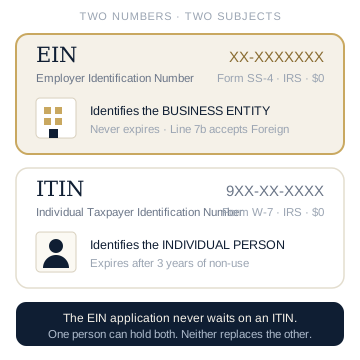
An EIN identifies a business entity to the IRS. An ITIN identifies an individual person who files a US return without a Social Security Number. Both carry 9 digits, and neither one substitutes for the other.
The distinction is the taxpayer, not the paperwork. A company and its owner are two separate taxpayers in the federal tax system, so each one carries its own identification number. A corporation files Form 1120 under an EIN. Its shareholder files Form 1040-NR under an ITIN. The 2 returns report different income and reach the IRS on different schedules.
An Employer Identification Number (EIN) is the 9-digit federal tax ID the IRS assigns to a business entity through Form SS-4. An Individual Taxpayer Identification Number (ITIN) is the 9-digit number the IRS assigns to a person through Form W-7 when that person owes a US filing obligation and holds no Social Security Number.
The word Employer in the EIN name misleads readers. An EIN carries no employment requirement. A single-member LLC with 0 employees holds an EIN, and a trust with 0 employees holds an EIN. Form SS-4 asks for an expected employee count, and 0 is a valid entry on that line.
Both numbers sit inside one category. Read the category on the ein vs tin page, which maps all 5 taxpayer identification number types, and compare the personal number a US resident already holds on the ein vs ssn page.
Do you need an EIN, an ITIN, or both?
A registered entity needs an EIN. A person with a US personal filing obligation needs an ITIN. An owner who has both a company and personal US income holds both numbers, on 2 separate applications.
The test runs on the name at the top of the form you are about to file. A form naming a company takes an EIN. A form naming a human takes an SSN or an ITIN. Nothing else decides it.
| The form names | Number required | Application | Example filing |
|---|---|---|---|
| A corporation | EIN | Form SS-4 | Form 1120 |
| A partnership | EIN | Form SS-4 | Form 1065 |
| A multi-member LLC | EIN | Form SS-4 | Form 1065 |
| A trust or an estate | EIN | Form SS-4 | Form 1041 |
| An employer paying wages | EIN | Form SS-4 | Form 941 |
| A person, no SSN | ITIN | Form W-7 | Form 1040-NR |
| A person, with an SSN | SSN | Form SS-5 | Form 1040 |
Source: IRS form instructions, verified July 2026.
A single-member LLC sits in both columns at once. The IRS disregards it for income tax, so its profit reaches the owner’s personal return, and the entity still holds an EIN of its own for banking, information returns, and employment tax. Read the classification detail on the ein for llc page.
Which do you apply for first, the EIN or the ITIN?
Apply for the EIN first. Form SS-4 line 7b accepts the entry Foreign, so the EIN application never waits on an ITIN. An ITIN application attaches a federal return, which the entity files under its EIN.
The dependency runs one direction. Form W-7 asks for a completed federal tax return, and a return that reports business income names the entity behind it. The entity reports under an EIN. Filing the ITIN first inverts the order and stalls both applications.
Line 7b is the reason the order works. The line asks for the responsible party’s SSN, ITIN, or EIN, and the instructions accept the word Foreign from a responsible party who holds none of the 3. That single entry removes the ITIN from the critical path. The application moves off the IRS online tool and onto fax, and the IRS returns the EIN in 4 business days.
The sequence that finishes fastest
- Form the entity with the state, and hold the formation document. The legal name on it becomes the name on Form SS-4 line 1.
- File Form SS-4 with Foreign on line 7b. Fax runs 4 business days. Mail runs 4 weeks.
- Open the business bank account and start operations against the EIN and the CP-575 letter.
- File Form W-7 for the ITIN when a personal US return is due, attaching that return.
Nothing in step 2 waits for step 4. A founder who needs a bank appointment in 3 weeks files the EIN application now and handles the personal number on the personal filing calendar.
Form SS-4 or Form W-7: which application applies?
Form SS-4 applies to an entity and produces an EIN. Form W-7 applies to a person and produces an ITIN. Form SS-4 files no identity document. Form W-7 files original identity documents or certified copies.
| Application step | Form SS-4, the EIN | Form W-7, the ITIN |
|---|---|---|
| Applicant on line 1 | The legal entity name | The individual person |
| Identity number asked for | Line 7b: SSN, ITIN, EIN, or Foreign | None, the form creates one |
| Identity document filed | None | Passport or 2 alternative documents |
| Return attached | None | A federal return, with narrow exceptions |
| Online route | Requires an SSN or ITIN | None, no online route exists |
| Fax route | 855-641-6935 or 855-215-1627 | None |
| Result document | CP-575 confirmation letter | CP-565 assignment notice |
| IRS fee | $0 | $0 |
Source: IRS instructions for Form SS-4 and Form W-7, verified July 2026.
The identity-document row explains most of the timing gap between the 2 applications. Form SS-4 asks the IRS to register an entity that a state already created, so the IRS verifies a name and a responsible party. Form W-7 asks the IRS to establish a human identity from scratch, so it inspects documents. No passport is filed with Form SS-4, on any of its 4 routes.
The fax numbers split by the entity address rather than by the applicant’s nationality. An entity with an address in a US state faxes 855-641-6935. An entity with an address outside the United States faxes 855-215-1627. The IRS international line for questions is 267-941-1099.
How do you tell an EIN and an ITIN apart on paper?
Count the digits before the first hyphen. An EIN prints 2 digits, a hyphen, then 7 digits. An ITIN prints 3 digits, a hyphen, 2 digits, a hyphen, then 4 digits, and it always starts with 9.
| Number | Pattern | Digit groups | First digit |
|---|---|---|---|
| EIN | XX-XXXXXXX | 2 and 7 | Any |
| ITIN | 9XX-XX-XXXX | 3, 2, and 4 | Always 9 |
| SSN | XXX-XX-XXXX | 3, 2, and 4 | Any except 9 |
Source: IRS, verified July 2026.
The 9-digit length is what makes the pair confusing. All 3 numbers hold 9 digits, so length proves nothing. The hyphen positions carry the whole signal. A number typed with no hyphens loses that signal entirely, which is why a bank form that strips punctuation produces the mismatch described further down this page.
How long does an EIN take compared to an ITIN?
An EIN takes 15 minutes online, 4 business days by fax, and 4 weeks by mail. The IRS publishes 7 weeks for an ITIN, and 9 to 11 weeks for an application sent from abroad or during peak season.
| Route | Number issued | Time | Cost |
|---|---|---|---|
| IRS online tool, SS-4 | EIN | 15 minutes | $0 |
| Fax, SS-4 | EIN | 4 business days | $0 |
| ein-number.com, Standard | EIN | 2–3 weeks total | $69 |
| ein-number.com, Fast | EIN | 7 business days total | $99 |
| Mail, SS-4 | EIN | 4 weeks | $0 |
| Mail, W-7 | ITIN | 7 weeks | $0 |
| Mail from abroad, W-7 | ITIN | 9 to 11 weeks | $0 |
Source: IRS-published processing times, verified July 2026. The IRS charges $0 for the number on every route. Business days are Monday to Friday, excluding US federal holidays.
The fastest EIN route finishes in 15 minutes and the slowest ITIN route runs 11 weeks. Those 2 endpoints are 15 minutes against 110,880 minutes, a 7,392-fold spread on 2 applications that both cost $0. Any plan that treats the 2 numbers as one task inherits the 11-week figure. Read the route-by-route breakdown on the how long does it take to get an ein page.
Does an EIN or an ITIN expire?
An EIN never expires and never renews, so year 2 and beyond cost $0. An ITIN expires after 3 consecutive years without appearing on a filed federal return, and a renewal files Form W-7 again.
The IRS assigns an EIN to an entity permanently. It survives a name change, an address change, and a change of responsible party. The IRS retires the number when the entity closes and never reassigns it to another business, which is why a closed entity's EIN never appears on a second company's return.
An ITIN carries a use requirement instead. The number stays live while it appears on a federal return, and it lapses after 3 straight years of absence. A lapsed ITIN on a filed return delays that return until the renewal completes.
Changes to the entity update the EIN record rather than replacing the number. A legal name change files a change business name with irs notice, and a change of address or responsible party files Form 8822-B within 60 days.
Where does each number go on a tax form?
The number follows the name on the line above it. A form naming an entity prints the EIN. A form naming a person prints an SSN or an ITIN. Form W-9, Part I takes whichever matches line 1.
| Form | Who files it | Number printed |
|---|---|---|
| Form 1120 | A corporation | EIN |
| Form 1065 | A partnership or multi-member LLC | EIN |
| Form 1041 | A trust or an estate | EIN |
| Form 941 | An employer, quarterly | EIN |
| Form 5472 | A foreign-owned single-member LLC | EIN |
| Form W-2, box b | An employer, per employee | EIN |
| Form W-9, Part I | The named payee | EIN, SSN, or ITIN |
| Form W-8BEN | A foreign individual | ITIN or foreign tax ID |
| Form 1040-NR | A non-resident individual | SSN or ITIN |
Source: IRS form instructions, verified July 2026.
Form W-9 is the line where the 2 numbers collide most. Line 1 names the taxpayer and line 6 carries the identification number, and the payer matches the pair against IRS records. A mismatch returns a B notice and starts backup withholding at 24 percent of the payment. Entering an ITIN under a company name on line 1 produces that mismatch every time.
Which bank account does each number open?
An EIN opens a business account in the company name. An ITIN supports a personal account in the person’s own name. A bank opening a business account verifies the EIN against the CP-575 letter before the account goes live.
Banks apply the same subject test the IRS applies. The account holder is either a company or a human, and the identification number matches the account holder. A business account under an ITIN fails at onboarding because the number identifies the wrong taxpayer.
The document a bank checks is the CP-575. The IRS issues exactly 1 CP-575 per EIN and never reprints it, so the replacement after a loss is a 147C letter. Read the anatomy of that document on the ein confirmation letter page, or recover a number you no longer hold on the lost ein number page.
Marketplace and payment-processor onboarding follows the same rule. A seller account registered to a company completes its tax interview with the entity name and the EIN. A seller account registered to an individual completes it with a personal number.
Why do EIN and ITIN applications get rejected?
Four causes account for most rejections: the wrong number type for the taxpayer, a legal name that fails the IRS name match, a blank line 7b on Form SS-4, and an ITIN application filed with no return attached.
The number type does not match the taxpayer. An ITIN entered where an entity belongs fails at the first check. The IRS matches the number class against the name class before it reads anything else on the form.
The legal name fails the IRS name match. The IRS derives a name control from the first 4 characters of the legal name. A comma, an abbreviation, or LLC written as L.L.C. changes that control and breaks the match.
Line 7b is blank on Form SS-4. Line 7b takes an SSN, an ITIN, an EIN, or the word Foreign. A blank line returns the application unprocessed. The word Foreign is a valid entry, not a workaround.
Form W-7 arrives with no federal return. The ITIN application attaches a return, because the number exists to serve a filing obligation. The only exceptions are the specific treaty and withholding cases listed in the Form W-7 instructions.
A rejected EIN application returns a reference number rather than a paragraph of explanation. Reference 101 signals a name conflict, and each further reference number the IRS returns carries its own separate cause. Work through the codes on the ein reference number 101 page.
What does an EIN cost compared to an ITIN?
The IRS charges $0 for an EIN and $0 for an ITIN. An EIN costs $0 in year 2 and beyond because it never renews. Filing services charge for preparation and filing, never for the number itself.
Neither number carries a government fee on any route. The difference between doing it yourself and paying a service is the difference between an unchecked form and one double-checked before it is sent.
Applying without a Social Security Number
Form SS-4 line 7b accepts the word Foreign, so the IRS issues EINs to responsible parties who hold no SSN and no ITIN. The application moves from the online tool to fax. The IRS fax line is 855-641-6935 for entities based in a US state and 855-215-1627 for international applicants. No identity document is filed with Form SS-4.
Have an SSN? irs.gov is free, and the online tool issues the EIN in 15 minutes.
| Filed by | Price | Accuracy guarantee | Year 2+ |
|---|---|---|---|
| Yourself, direct to the IRS | $0 | Not stated | $0 |
| ein-number.com, Standard | $69 | Accuracy guaranteed · 2–3 weeks total | $0 |
| ein-number.com, Fast | $99 | Accuracy guaranteed · 7 business days total | $0 |
| Northwest | $200 | Not stated | $0 |
| ZenBusiness | $99 | Not stated | $0 |
Competitor prices verified July 2026. Northwest reflects the no-SSN rate. Business days are Monday to Friday, excluding US federal holidays.
The IRS charges $0 for an EIN through every method. The $69 Standard tier covers preparation, a senior error review, fax filing within 8 business days, and IRS monitoring across 4 tracked stages, 2–3 weeks total. The $99 Fast tier files within 24 hours with the IRS call included, 7 business days total. You can have EIN filing, accuracy guaranteed or file it yourself for nothing.
Which primary sources back this page?
Every fee, deadline, form number and phone line above is taken from the 4 official documents below. No third-party blog is cited.