Which events give a trust its own EIN?
Six events decide it. Creating a revocable trust does not. The grantor’s death, an irrevocable trust, a testamentary trust, and a split into subtrusts each do. A trustee change does not.
The rule behind all 6 rows is one question: does the IRS treat the trust as a separate taxpayer, or does it look through the trust to a person. While the grantor keeps the power to revoke, the IRS looks through. The trust owns assets, signs contracts, and holds title, and it still reports on a human being’s number.
| # | Event | Own EIN | Number it reports under otherwise |
|---|---|---|---|
| 1 | A revocable living trust is created and funded | No | The grantor's SSN, under the grantor trust rules |
| 2 | The grantor of a revocable trust dies | Yes | The grantor's SSN, through the date of death only |
| 3 | An irrevocable trust is created during the grantor's life | Yes | No prior number exists |
| 4 | A testamentary trust is funded out of a will | Yes | The estate's EIN, during administration |
| 5 | One trust divides into a marital and a bypass subtrust | Yes, one EIN per subtrust | The original trust's EIN |
| 6 | The trustee changes, or the trust moves state | No | The same EIN continues without a break |
Source: IRS Form SS-4 instructions and the grantor trust rules, verified July 2026.
Row 5 surprises trustees the most. A single document that divides into a marital share and a bypass share creates 2 taxpayers on 1 date, and each files its own Form SS-4. The comparable question for business entities sits on the when do you need a new EIN page.
How does a grantor trust report income with no EIN?
The trustee gives every payor the grantor’s name and Social Security Number instead of a trust EIN. Income lands on the grantor’s Form 1040, and the trust files no Form 1041 for that year.
This is the alternative reporting method the grantor trust regulations allow, and it is why a funded living trust holds no 9-digit number at all. A brokerage receives the grantor’s SSN on the Form W-9, issues the Form 1099 in the grantor’s name, and the IRS matching system finds the income on the 1040 where it expects it.
A second method exists: the trustee obtains an EIN for the trust and files Forms 1099 from the trust to the grantor, moving the income to the 1040 in 2 steps rather than 1. Both methods are legitimate. The first costs $0 and creates no filing. The second creates an annual 1099 obligation for the trustee.
Banks complicate the choice. Some institutions decline to open a trust account against an SSN and ask for an EIN in the account file, which is a bank policy rather than a tax rule. A trustee in that position applies for the number and keeps reporting on the grantor’s 1040.
What happens to the EIN when the grantor dies?
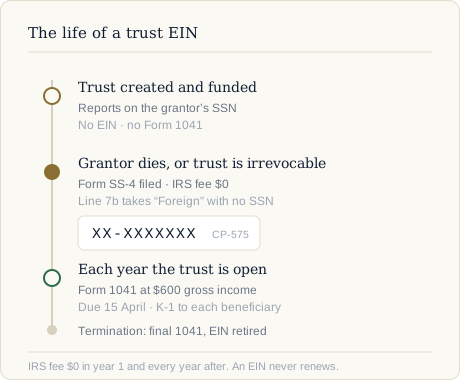
The revocable trust becomes irrevocable on the date of death and becomes its own taxpayer. It applies for an EIN, and the grantor’s SSN covers income only through that date.
Two returns split the calendar year. Income earned through the date of death belongs on the decedent’s final Form 1040. Income earned from the day after belongs on the trust’s Form 1041, filed under the new EIN. The date of death is the line, not the date the trustee learns of the death and not the date the bank retitles the account.
A section 645 election, filed on Form 8855, merges a qualified revocable trust with the decedent’s estate for income tax and produces 1 combined Form 1041 under the estate’s EIN. The election period runs to 2 years after the date of death when no estate tax return is required. The trust still needs its own EIN to make the election.
The trustee also files Form 56 to notify the IRS of the fiduciary relationship, which is what routes IRS notices to the trustee rather than to a deceased person’s address. The parallel process for a decedent’s estate is on the ein for estate page.
When must a trust file Form 1041?
A trust files Form 1041 for any year with $600 or more of gross income, any taxable income, or a beneficiary who is a nonresident alien. Any one of the 3 tests is enough.
| Test or deadline | Threshold | Form |
|---|---|---|
| Gross income for the tax year | $600 or more | Form 1041 |
| Taxable income for the tax year | Any amount above $0 | Form 1041 |
| A beneficiary who is a nonresident alien | 1 beneficiary is enough | Form 1041 |
| Tax year a trust must adopt | Calendar year, closing 31 December | SS-4 line 12 |
| Return due date | 15th day of the 4th month, 15 April | Form 1041 |
| Extension length | 5.5 months, to 30 September | Form 7004 |
| Statement to each beneficiary | 1 per beneficiary | Schedule K-1 |
| Distributions counted in the prior year | First 65 days of the year | 1041, 65-day election |
Source: IRS Form 1041 instructions and Internal Revenue Code sections 644 and 663(b), verified July 2026.
The calendar-year rule is the one that separates trusts from estates. An estate elects a fiscal year, which moves its first return further out. A trust other than a tax-exempt or charitable trust closes on 31 December, so SS-4 line 12 reads December on those applications.
Trust brackets compress hard. A trust reaches the top federal bracket at a fraction of the income an individual needs to reach it, which is why the 65-day rule matters: a distribution made in the first 65 days of a year is treated as made on the last day of the prior year and shifts the tax to a beneficiary’s lower bracket.
Which Form SS-4 lines does a trustee answer differently?
Seven lines carry trust-specific answers: line 1 the trust name, line 3 the trustee, line 7b the responsible party number, line 9a Trust, line 10 Created a trust, line 11 the funding date, line 12 December.
| Line | What a trust enters | What gets the application rejected |
|---|---|---|
| 1 | The legal name of the trust, copied from the trust instrument | The trustee's personal name, or a shortened version of the trust name |
| 2 | Left blank unless the trust runs a trade name | A nickname used by the family |
| 3 | The trustee, entered as the care-of name | A blank line 3 on a trust application |
| 4a, 4b | The mailing address the CP-575 is sent to | An address the trustee cannot receive post at |
| 7a, 7b | The grantor or trustee, with an SSN, an ITIN, or the entry Foreign | A blank line 7b, which stops the application |
| 9a | Trust, with the grantor's SSN entered beside it | Estate, or the wrong entity box |
| 10 | Created a trust, with the type written in | Banking purpose, on a newly created trust |
| 11 | The date the trust was funded | The date the document was signed, when funding came later |
| 12 | December, because a trust uses a calendar year | A fiscal month copied from an estate application |
| 18 | Whether this trust ever held an EIN before | Yes with no prior number listed |
Source: IRS Form SS-4 and its instructions, verified July 2026.
Line 1 is the row to copy with the most care. The IRS builds a name control from the first 4 characters it reads on the name line, and a trust name that begins with the word The on one document and with a surname on another produces 2 different controls. Copy the name from the instrument exactly, including the date in the title when the instrument carries one.
The full line-by-line walkthrough for every entity type sits on the how to apply for an EIN page, and the single-owner comparison sits on the ein for sole proprietorship page.
What does a bank check before opening a trust account?
Three documents: the CP-575 or a 147C letter carrying the EIN, the trust instrument or a certification of trust, and identification for each acting trustee. The legal name must match the CP-575 exactly.
The match is character for character. A trust titled with a comma before the date on the instrument and without one on the account form fails the check, and so does an abbreviated word. Banks compare against the IRS document rather than against the trust deed, because the CP-575 is the record that proves the IRS paired the 9 digits with that exact legal name.
The CP-575 prints once and the IRS never reprints it. When it is missing, the replacement is a 147C letter, issued at $0 to an authorized person, and the anatomy of the original is on the CP-575 page.
Successor trustees hit one extra check. A bank verifies the authority to act, which means the section of the instrument naming the successor plus the death certificate or the incapacity certification the instrument requires. The EIN does not change when the trustee does.
How does a trustee with no SSN get an EIN for a trust?
By fax. Form SS-4 line 7b accepts the entry Foreign, so the IRS assigns EINs to responsible parties with no SSN and no ITIN. The IRS returns the number within 4 business days.
The online EIN Assistant is the only route that requires an SSN or ITIN, and it is the reason a foreign trustee reads that no EIN is available. The paper form carries no such requirement. Line 7b takes the word Foreign, no identity document is filed with Form SS-4, and no passport upload is part of the process.
The fax number is 855-641-6935 for a trust based in a US state and 855-215-1627 for an international applicant. The application must carry a return fax number, because the IRS replies on the same channel; a missing return number sends the answer to the 4-week mail timetable instead. The international phone line, 267-941-1099, runs Monday to Friday, 6 a.m. to 11 p.m. Eastern Time.
Have an SSN? irs.gov is free, and the online tool issues the EIN in 15 minutes. The complete no-SSN reference is on the EIN without SSN page.
How long does an EIN for a trust take?
Fifteen minutes through the IRS online tool, the length of one call by phone, 4 business days by fax, and 4 weeks by mail. The IRS charges $0 on all 4 routes.
| Route | Time to the EIN | Trustee SSN required | Cost |
|---|---|---|---|
| IRS online EIN Assistant, Mon–Fri 7 a.m. to 10 p.m. ET | 15 minutes | Yes | $0 |
| IRS phone, 267-941-1099 | During the call | No | $0 |
| Fax, 855-641-6935 or 855-215-1627 | 4 business days | No | $0 |
| 4 weeks | No | $0 | |
| ein-number.com, Standard | 2–3 weeks total | No | $69 |
| ein-number.com, Fast | 7 business days total | No | $99 |
Source: IRS, verified July 2026.
Two limits shape the plan. The IRS issues 1 EIN per responsible party per day, so a trustee splitting a trust into 2 subtrusts on the online tool finishes the second number on the following day. And an EIN takes up to 2 weeks to enter IRS permanent records, so a 15-minute number opens a bank account immediately while electronic filing waits. Every route is compared on the how long does it take to get an EIN page.
What does a foreign trust file beyond the EIN?
Form 3520-A each year and Form 3520 on transfers and distributions. Both carry a penalty floor of $10,000. A foreign trust applies for its EIN on the same Form SS-4, at $0.
| Form | Who files it | Due date | Penalty exposure |
|---|---|---|---|
| Form 3520-A | The foreign trust with a US owner | 15th day of the 3rd month, 15 March | Greater of $10,000 or 5% of the gross value owned, IRC 6677 |
| Form 3520 | A US person transferring to or receiving from the trust | With that person's income tax return | Greater of $10,000 or 35% of the gross reportable amount, IRC 6677 |
| Form 56 | The trustee, on taking the role | On appointment | None, it routes IRS notices to the trustee |
Source: IRS Forms 3520 and 3520-A instructions and Internal Revenue Code section 6677, verified July 2026.
The EIN is what makes those filings possible. Form 3520-A asks for the foreign trust’s EIN on page 1, and a US owner who cannot supply it files an incomplete return that runs the same penalty clock as no return. That is why a foreign trust with a single US beneficiary applies for a number it will use on 1 form a year.
A foreign trustee applies by fax on 855-215-1627 with line 7b reading Foreign. Nothing about foreign status changes the IRS fee, which stays $0, and nothing about it requires a US visit or a US identity number.
What happens to the EIN when the trust ends?
The trustee files a final Form 1041 marked final return, issues 1 Schedule K-1 per beneficiary, and mails the IRS a closing letter. The 9 digits are retired and never reassigned.
Termination is a filing event rather than a cancellation. The IRS does not delete an EIN; it closes the business account attached to it. The final Form 1041 carries the same $0 filing fee, and unused losses and deductions in the final year pass to the beneficiaries on the K-1 rather than expiring inside the trust.
Order matters at the end. Distribute, then file the final return, then close the account, because a closed account with a later distribution reopens the reporting. The closing letter procedure and the exact IRS address are on the cancel EIN page.
How much does an EIN for a trust cost?
The IRS charges $0 for an EIN on every route, in every year, for every trust type. A filing service charges for preparation, a second review, and filing, not for the number.
| Filed by | Price | Total turnaround | Year 2+ |
|---|---|---|---|
| The trustee, direct to the IRS | $0 | Not stated | $0 |
| ein-number.com, Standard | $69 | 2–3 weeks total, filed by fax within 8 business days | $0 |
| ein-number.com, Fast | $99 | 7 business days total, filed within 24 hours | $0 |
| Northwest | $200 | Not stated | $0 |
| ZenBusiness | $99 | Not stated | $0 |
| Rocket Lawyer | $59.99 | Not stated | $0 |
Competitor prices verified July 2026. Northwest reflects the no-SSN rate. Business days are Monday to Friday, excluding US federal holidays.
The $69 Standard tier covers preparation of Form SS-4 against the trust instrument, a senior error review, fax filing within 8 business days, and delivery of the 9-digit EIN and the official IRS CP-575 letter, 2–3 weeks in total. The $99 Fast tier files within 24 hours and adds the IRS phone follow-up, 7 business days in total. The number itself never costs money, and an EIN never renews, so year 2 and every year after cost $0. You can get started with us or file it yourself for nothing. The full breakdown is on the EIN cost page, and the business-entity version is on the ein for llc page.
Which primary sources back this page?
Every fee, deadline, form number and phone line above is taken from the 3 official documents below. No third-party blog is cited.