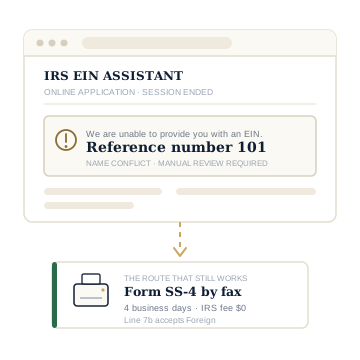
What is EIN reference number 101?
EIN reference number 101 is a name conflict. The IRS online tool compared the entity name against its records across all 50 states and every entity type, found a close match, and stopped the automated assignment for manual review.
The online EIN Assistant assigns numbers without a human in the loop. That speed is the reason it finishes in 15 minutes, and it is also the reason it refuses anything ambiguous. When the name comparison returns a near match, no automated rule exists to decide whether the two entities are the same organization. The tool ends the session and prints a reference number instead.
Reference 101 carries no penalty, no flag on the entity, and no fee. Nothing is filed, nothing is rejected on the merits, and no record of the attempt attaches to the business. The application simply never reached an assignment. The IRS charges $0 to try again through any route.
The comparison is national, not by state. Two businesses registering the same name in 2 different states is normal at the state level, because each Secretary of State maintains its own register. The IRS holds 1 national list. A name that cleared its state filing collides at the federal level the first time anyone applies for an EIN with it.
What causes EIN reference number 101?
Five situations produce reference 101: a similar name in another state, an existing EIN for the same entity, a name entered differently from the formation document, a foreign address the tool cannot parse, and an entity type mismatch.
A similar name already exists in another state. The IRS list is national and covers all 50 states plus the District of Columbia. Two entities whose legal names share the same first 4 characters collide even when they sit in 2 different states in unrelated industries.
The entity already holds an EIN. An LLC that received an EIN in an earlier year matches itself. The IRS issues 1 EIN per entity and never issues a second one for the same organization, so the correct next step is recovery rather than a new application.
The name was entered differently from the formation document. The IRS builds a name control from the first 4 characters of the legal name. A comma, a period, an ampersand, or LLC written as L.L.C. changes that 4-character string and changes the comparison result.
The address is outside the United States. The online tool validates addresses against US postal formats. A foreign province, a postal code with letters, or a country field the form does not carry stops the automated path, and reference 101 is one of the codes that follows.
The entity type and the name suffix disagree. A name ending in Inc. entered as a partnership, or a name ending in LLC entered as a corporation, fails the consistency check. The suffix on the formation document decides which entity-type box on Form SS-4 line 9a applies.
The second cause is worth checking before anything else. An entity that already holds an EIN needs the number recovered, not reissued. Work through the recovery methods on the EIN number lookup page, and read the free official sources on the ein lookup free page.
How do you fix EIN reference number 101?
Fax Form SS-4 to the IRS. A reviewer resolves the name conflict that the automated tool refused to decide. Fax 855-641-6935 for a US-based entity and 855-215-1627 for an international applicant. The reply takes 4 business days.
The fix is a change of channel, not a change of facts. The name stays the same, the entity type stays the same, and the responsible party stays the same. What changes is who reads the form: a person instead of a rule set. That is the entire mechanism behind the fax route, and it is why 4 business days by fax succeeds where 15 minutes online failed.
Step 1: Confirm the entity holds no EIN already
Check the CP-575 letter, a filed tax return, and the business bank file. The IRS issues 1 EIN per entity and never issues a second. An EIN that already exists is recovered through a 147C letter at $0, and a new application for the same entity returns 101 every time.
Step 2: Copy the legal name character for character
Open the formation document filed with the state and copy line 1 of Form SS-4 from it exactly. Punctuation counts, spacing counts, and the entity suffix counts. The IRS name control uses the first 4 characters, so a single stray period changes the string the comparison runs against.
Step 3: Complete Form SS-4 with a return fax number
Line 7b accepts the entry Foreign when the responsible party holds no SSN and no ITIN. Line 9a records the entity type. The return fax number is the single field that decides the reply channel: with it, the IRS replies in 4 business days, and without it the reply follows the 4-week mail timetable.
Step 4: Fax the form to the correct IRS line
Use 855-641-6935 when the entity has a legal residence or principal office in a US state. Use 855-215-1627 when it does not. Faxing the international form to the domestic line adds a rerouting delay on top of the 4 business days, so the choice between the 2 numbers matters more than the send time.
| Form SS-4 field | What goes in it | Why 101 turns on it |
|---|---|---|
| Line 1, legal name | The name exactly as the state registered it | The comparison that produced 101 runs on this field |
| Line 7b, responsible party ID | An SSN, an ITIN, or the word Foreign | Foreign is accepted, so no SSN is required |
| Line 9a, entity type | The 1 box that matches the formation document | A suffix that disagrees with the type fails the check |
| Line 18, prior EIN question | Yes when the entity ever held an EIN | An entity that already holds an EIN matches itself |
| Return fax number | A fax line that receives the reply | It sets the reply at 4 business days instead of 4 weeks |
Source: IRS Form SS-4 and its instructions, verified July 2026.
What do the other EIN reference numbers mean?
Thirteen reference numbers exist: 101 through 107, 109, 110, 112, 113, 114, and 115. Each names a different reason the automated assignment stopped. Every one of the 13 leaves the fax route open at $0.
| Code | Meaning | What triggered it | Route that works |
|---|---|---|---|
| 101 | Name conflict | The entity name resembles a name already in IRS records, across all 50 states and every entity type. | Fax Form SS-4 for manual review |
| 102 | SSN or ITIN mismatch | The responsible party's SSN or ITIN does not match the records the IRS checks it against. | Correct the entry, or fax Form SS-4 |
| 103 | Existing EIN conflict | The EIN entered for a related entity conflicts with the address or entity data already on file. | Verify the related EIN, then fax |
| 104 | Third-party designee conflict | The Third Party Designee block carries the same phone or fax number as the applicant. | Give the designee a distinct number |
| 105 | Too many attempts | The application was submitted too many times from the same session in one day. | Apply on a later day, or fax |
| 106 | Sole proprietor, no EIN on file | A single-member entity was entered without the filing requirement the IRS expects for that structure. | Recheck the entity type, then fax |
| 107 | Too many single-member LLCs | More than one single-member LLC was entered under the same owner in one application chain. | File each entity separately by fax |
| 109 | System issue | The IRS system did not complete the assignment during the session. | Apply on a later day, or fax |
| 110 | System issue | The IRS system did not complete the assignment during the session. | Apply on a later day, or fax |
| 112 | System issue | The IRS system did not complete the assignment during the session. | Apply on a later day, or fax |
| 113 | System issue | The IRS system did not complete the assignment during the session. | Apply on a later day, or fax |
| 114 | Daily limit reached | The IRS issues 1 EIN per responsible party per day, and that party already received one. | Apply the next business day |
| 115 | Date of death on record | The records for the responsible party's identity number carry a date of death. | Correct the responsible party, then fax |
Source: IRS online EIN Assistant messages, verified July 2026.
The codes 108 and 111 do not appear in the sequence the tool returns. That gap is why the list runs to 13 entries rather than 15 across the 101 to 115 range.
What is EIN reference number 102?
Reference number 102 is an identity mismatch. The SSN or ITIN entered for the responsible party did not match the records the IRS checks it against. The fax route accepts the word Foreign on line 7b instead.
Two things produce 102. The first is a data error: a transposed digit, or a name spelled differently from the one attached to the identity number. The second is structural: the responsible party holds no SSN and no ITIN at all, which the online tool has no field for. The online EIN Assistant is the only one of the 4 IRS routes that requires an identity number.
The structural case is not an error to correct. Form SS-4 line 7b accepts the entry Foreign, and the IRS assigns EINs on that basis every business day. The application moves to fax, takes 4 business days, and costs $0. No identity document is filed with Form SS-4 in either case.
The name attached to the identity number matters as much as the digits. A married name recorded with one agency and a maiden name recorded with another produces a mismatch on 2 correct records. Copying the name from the identity document itself removes that failure.
What is EIN reference number 103?
Reference number 103 is an existing EIN conflict. The EIN entered for a related entity does not agree with the address or entity data the IRS already holds for that number. The fax route sends it to a reviewer.
Code 103 appears on applications that reference a second entity: a parent company, a predecessor, or an entity whose EIN the applicant supplied on the form. The IRS holds 1 address and 1 legal name for every EIN it issued. A reference to that EIN with a different address is 2 records that disagree, and the tool stops rather than choosing between them.
The correction runs through the record, not the application. An address the IRS holds for an existing EIN is updated on Form 8822-B, and that update is a separate filing from the new EIN application. Read the line-by-line procedure on the Form 8822-B page.
What is EIN reference number 104?
Reference number 104 is a third-party designee conflict. The designee in the Third Party Designee block of Form SS-4 carries the same phone or fax number as the applicant, and the IRS requires those 2 parties to be separately reachable.
A third-party designee is a person authorized to receive the EIN on the applicant's behalf. The authorization exists so the IRS can release the number to someone other than the responsible party, which only works when the 2 contacts are distinguishable. Identical contact numbers make the designation meaningless, and the tool refuses it.
Code 104 has the simplest fix of the 13. Enter a phone and fax for the designee that differ from the applicant's, or leave the designee section blank entirely. A blank Third Party Designee block sends the EIN to the responsible party directly, which removes the conflict at its source.
What is EIN reference number 105?
Reference number 105 is an attempt limit. The application was submitted too many times from the same session in 1 day, and the tool stopped accepting further attempts. A later day clears it, and fax works immediately.
Code 105 is the code that repeat attempts create. An applicant who receives 101 and keeps resubmitting in the same session receives 105 on top of it, and the second of the 2 codes hides the first. Nothing about the entity caused it. The block sits on the session and the day, and it does not attach to the business.
The practical lesson runs in one direction: stop after the first code. The name comparison behind 101 returns the same result on attempt 5 as on attempt 1, because the underlying records did not change between them. Resubmitting trades no new information for a day of tool access.
What are EIN reference numbers 106 and 107?
Reference 106 is a sole-proprietor filing-requirement mismatch. Reference 107 is more than 1 single-member LLC entered under the same owner in 1 application chain. Both resolve by filing each entity separately on Form SS-4.
Code 106 turns on the relationship between the entity type and the filing requirement the IRS expects for it. A sole proprietor without employees reports under a Social Security Number, so the tool checks what the EIN is for before assigning one. Selecting the entity type that matches the formation document on line 9a resolves the mismatch.
Code 107 turns on volume. The online tool handles 1 entity per application, and a founder holding 3 single-member LLCs files 3 separate Forms SS-4. Each entity receives its own 9-digit EIN, and no EIN is ever shared between 2 legal entities. The daily limit in code 114 applies across those filings.
Read which structures need their own number, and which changes require a new one, on the EIN vs TIN page.
What are EIN reference numbers 109, 110, 112, and 113?
These 4 codes are system issues. The IRS did not complete the assignment during the session, and nothing in the application caused it. A later day clears them, and the fax route bypasses the tool entirely at $0.
The online EIN Assistant runs Monday to Friday, 7 a.m. to 10 p.m. Eastern Time. Outside those hours the tool is closed rather than broken. Inside them, these 4 codes report that the assignment did not finish, and no correction to Form SS-4 changes the outcome.
The distinction that matters is between a code that describes your data and a code that describes the system. The 7 codes 101, 102, 103, 104, 106, 107, and 115 point at a field on the form. The 5 codes 105, 109, 110, 112, and 113 point at the tool. Correcting a form to answer a system code changes nothing.
A deadline changes the calculation. A session retried the next day risks the same result, while a fax sent the same afternoon starts a 4-business-day clock that runs independently of the tool. Compare all 5 routes end to end on the how long does it take to get an EIN page.
What is EIN reference number 114?
Reference number 114 is the daily limit. The IRS issues 1 EIN per responsible party per day, counting every entity that person is responsible for. The next business day clears it, and the IRS fee stays $0.
The limit attaches to the person, not the company. A founder forming 4 LLCs on a Monday receives 1 EIN that day and waits until Tuesday for the second. Four entities take 4 business days through the online tool for that reason alone, before any other code appears.
The fax route follows the same limit, and it absorbs it better. Four Forms SS-4 faxed together enter the queue at once and come back inside the 4-business-day window, because the wait is processing time rather than 4 separate sessions. The responsible party field is what the limit counts, so naming a different authorized person for a different entity separates the filings.
What is EIN reference number 115?
Reference number 115 reports a date of death on the records for the responsible party's identity number. The application names a different living responsible party, or it proceeds as an estate filing by fax.
Code 115 appears on 2 kinds of application. The first is an error: a digit entered incorrectly lands on an identity number whose records carry a date of death. The second is a genuine estate or trust application, where the decedent's number belongs on the form but the responsible party is the executor or the trustee.
The responsible party is the living person who controls the entity. An estate names its executor, a trust names its trustee, and a company names an owner or officer. Correcting that field to a living person resolves the code, and the fax route carries the application for $0 either way.
How do you file after a reference number rejection?
Complete Form SS-4 and fax it. Line 7b accepts the word Foreign when the responsible party holds no SSN. Fax 855-641-6935 for a US-based entity and 855-215-1627 for an international applicant. The reply takes 4 business days.
Applying without a Social Security Number
Form SS-4 line 7b accepts the word Foreign, so the IRS issues EINs to responsible parties who hold no SSN and no ITIN. The application moves from the online tool to fax. The IRS fax line is 855-641-6935 for entities based in a US state and 855-215-1627 for international applicants. No identity document is filed with Form SS-4, and no passport upload is requested at any stage.
Have an SSN? irs.gov is free, and the online tool issues the EIN in 15 minutes. International applicants reach the IRS at 267-941-1099, Monday to Friday, 6 a.m. to 11 p.m. Eastern Time, and that line assigns the number during the call.
| Filed by | Price | Total turnaround | Year 2+ |
|---|---|---|---|
| Yourself, direct to the IRS | $0 | 4 business days by fax | $0 |
| ein-number.com, Standard | $69 | 2–3 weeks | $0 |
| ein-number.com, Fast | $99 | 7 business days | $0 |
| Northwest | $200 | Not stated | $0 |
| ZenBusiness | $99 | Not stated | $0 |
Competitor prices verified July 2026. Northwest reflects the no-SSN rate. Business days are Monday to Friday, excluding US federal holidays.
The IRS charges $0 for an EIN through every route, including the fax refile after a reference number. The $69 Standard tier covers preparation with senior error review, fax filing within 8 business days, 4 tracked stages, IRS monitoring, and the EIN by email, 2–3 weeks total. The $99 Fast tier files within 24 hours and adds the IRS phone follow-up, 7 business days total. Every filing is double-checked before submission, and if we make an error, full refund, no conditions. You can have EIN filing, accuracy guaranteed or file the same form yourself for nothing.
Which EIN reference numbers clear on their own?
Seven codes point at a field on Form SS-4: 101, 102, 103, 104, 106, 107, and 115. Five point at the tool: 105, 109, 110, 112, and 113. Code 114 points at the calendar.
The 3 groups behave differently, and the group decides the next move. A form code stays until a reviewer or a corrected field resolves it, so waiting achieves nothing. A tool code carries no instruction at all, so a later session or a fax resolves it. Code 114 sits alone: the 1-per-responsible-party-per-day limit expires on its own, and the next business day clears it without a single edit to the form.
| Group | Codes | Count | Clears by waiting | Fastest route |
|---|---|---|---|---|
| Points at a form field | 101, 102, 103, 104, 106, 107, 115 | 7 of 13 | No | Fax Form SS-4, 4 business days |
| Points at the tool | 105, 109, 110, 112, 113 | 5 of 13 | Yes, on a later day | Fax Form SS-4, 4 business days |
| Points at the calendar | 114 | 1 of 13 | Yes, the next business day | Wait 1 business day, or fax |
Source: IRS online EIN Assistant messages and IRS Form SS-4 instructions, verified July 2026.
One rule crosses all 3 groups: the fax route works on every 1 of the 13 codes, at an IRS fee of $0, in 4 business days. That is why the group matters for choosing to wait and never for choosing to file. An applicant with a deadline files by fax on the day the code appears, whichever of the 13 it was.
Does reapplying online clear an EIN reference number?
No. The same comparison runs on every attempt, so the same code returns. Repeat submissions add reference number 105, which blocks the tool for the day. Codes 101 through 104 need a reviewer, and fax reaches one.
The reasoning holds for all 13 codes. The 7 codes that describe your data return identically until the data changes, and the data on a formation document does not change. The 5 codes that describe the system clear with time rather than with attempts. Code 114 clears on the next business day and on no other schedule. In none of the 3 groups does a resubmission on the same day improve the result.
Two checks belong before any refile. Confirm the entity holds no EIN already, because a prior number makes a new application unnecessary. Confirm the legal name matches the state filing character for character, because the 4-character name control decides the comparison. Both checks cost $0, and both run against 2 documents you already hold.
When the number turns out to exist, recovery replaces application. The IRS reissues an assigned EIN as a 147C letter at $0, and the request procedure sits on the 147C letter page. To confirm a counterparty EIN rather than your own, start with the ein search by company name page.
Which primary sources back this page?
Every fee, deadline, form number and phone line above is taken from the 3 official documents below. No third-party blog is cited.