Table of contents
- What is a reverse EIN lookup?
- How do you reverse look up a public company EIN?
- How do you reverse look up a nonprofit EIN?
- Can you reverse look up a private company EIN?
- Why would you run a reverse EIN lookup?
- What do you do when the reverse lookup fails?
- What does the EIN format tell you about a number?
- How do you verify a number a reverse lookup returned?
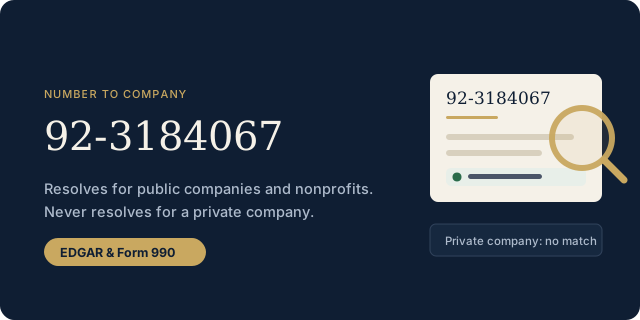
A reverse EIN lookup works in reverse of a normal search: you hold the 9-digit number and want the company. It succeeds for public companies through SEC EDGAR and for nonprofits through IRS Form 990. It fails for private companies, because no public database maps private EINs to names.
Most pages on this topic promise a universal search that does not exist. This one separates the cases that resolve from the case that never will, so the search either finishes in 3 minutes or stops before it wastes an afternoon.
What is a reverse EIN lookup?
A reverse EIN lookup starts with a 9-digit EIN and identifies the entity it belongs to. A standard lookup runs the other direction, starting with a company name and finding its number.
The direction changes which sources work. Searching by company name uses indexes built around names, and every public filing system is organized that way. Searching by number needs a source that treats the EIN itself as a key, and few do.
The reason people run one is almost always verification. A number appears on an invoice, a W-9, or a contract, and the reader wants to confirm it belongs to the business that supplied it.
The honest headline is narrow success. Two categories resolve reliably, one does not, and knowing which case you hold saves the hours that a private company search would waste.
How do you reverse look up a public company EIN?
Search SEC EDGAR. Every 10-K and 10-Q filing header carries the filer's EIN alongside the registrant name, and the archive is free and searchable through the full-text system.
Federal securities law requires those filings, which is what makes this category work. The EIN appears in the header as the IRS Employer Identification Number, next to the state of incorporation and the registrant's exact legal name.
The match is authoritative because the company filed it under penalty of law. An EDGAR result is stronger evidence than any aggregator, which is why it belongs first in any verification workflow.
The limit is coverage. EDGAR holds public registrants and their filing subsidiaries, and nothing else. A number that returns no EDGAR result simply means the entity is not an SEC filer.
How do you reverse look up a nonprofit EIN?
Search the IRS Tax Exempt Organization Search, which accepts an EIN directly and returns the registered organization. Form 990 filings print the same EIN on page 1, and both sources cost $0.
Nonprofits are the one category the IRS itself makes searchable by number. Tax-exempt organizations file Form 990 annually, the IRS publishes those returns, and the search tool indexes the EIN as a lookup key.
A result confirms three things at once: the organization exists, its exempt status, and the legal name attached to the number. Donors verifying a charity before giving get all three in about 3 minutes.
Watch the entity rather than the brand. National charities operate multiple registered entities, and a chapter holds a different EIN from its parent, so the record you want is the one that issues the receipt.
Can you reverse look up a private company EIN?
No public database maps a private company EIN to its name. The IRS operates no public search for private EINs, and no free or paid service holds a complete index of them.
This is the answer most reverse-lookup pages avoid. A private company never files its EIN into a public record, so there is no dataset to search. Sites promising otherwise are reselling scraped filings that cover the same public and nonprofit entities already available for free.
The route that does work is direct. Ask the business for a signed Form W-9, where the Part I TIN box carries the number and the signature attests that it is correct. A vendor, client, or payment processor requests one as routine paperwork.
A search returning nothing has produced the accurate result rather than a failed one. Reading it as accurate saves the hours that a hunt through aggregators would consume.
Why would you run a reverse EIN lookup?
Four situations drive it: verifying a number on a signed W-9, matching an EIN on a 1099 to the payer, checking a charity before donating, and confirming a counterparty before signing a contract.
The W-9 case is the most common. A vendor returns the form with a 9-digit number, and the business paying them wants confirmation before reporting payments under it. An EIN reported against the wrong name produces a mismatch notice from the IRS months later.
The 1099 case runs the same direction. A recipient holding a 1099 with an unfamiliar payer EIN wants to identify the issuer to resolve an amount that does not match their own records.
Charity verification is the case with the cleanest answer, because nonprofit EINs are published. A donor confirms the organization, its exempt status, and its legal name in about 3 minutes before giving.
Contract due diligence is the weakest case for this method. A private counterparty will not appear in any public index, so the request goes to the company directly rather than to a search tool.
What do you do when the reverse lookup fails?
Ask the business for a signed Form W-9, where the Part I TIN box carries the EIN. When the number is your own, request a 147C letter from the IRS, which reissues it to an authorized person.
A signed W-9 outperforms any database for a private company. The signature attests that the number is correct, and the form arrives with the exact legal name attached, which is the pairing that actually matters.
For your own entity, the 147C is the official route. The IRS releases EIN information to the responsible party or another authorized person, and verifies that authority before releasing anything. International applicants reach the IRS at 267-941-1099.
Rule out a transcription error before either step. The digit 0 and the letter O look alike in scanned documents, and so do 1 and 7. Re-reading the number from the original rather than a photocopy resolves a share of failed searches on its own.
Treat a genuinely empty result as information. It tells you the entity is private, which redirects the effort from searching to asking, and that redirect is the fastest part of the whole process.
What does the EIN format tell you about a number?
An EIN carries 9 digits, printed as 2 digits, a hyphen, then 7. The leading 2 digits are a prefix the IRS assigns by processing campus, and no digit in the number encodes the state or the industry.
The prefix is the only part with meaning, and it is weaker than it looks. It records which IRS campus or system issued the number, not where the business operates. A company in Texas holds a prefix from wherever the IRS processed the application.
Format checking rules out typos, not fraud. A 9-digit string in the right shape is necessary and nowhere near sufficient, because any 9 digits can be typed in that pattern. Only a name match against IRS records confirms a number is real.
The hyphen placement separates an EIN from a Social Security Number at a glance. An SSN prints as 3 digits, 2 digits, then 4. An EIN prints as 2 then 7, which is why a number written 12-3456789 is an EIN and 123-45-6789 is not.
No part of the number changes over time. An EIN issued in 1998 keeps the same 9 digits today, through name changes, address changes, and moves between states.
How do you verify a number a reverse lookup returned?
Match the EIN to the exact legal name the IRS holds. A valid EIN carries 9 digits in a 2-digit and 7-digit format, and the IRS confirms the pairing through a 147C letter.
Format proves nothing on its own. Any 9-digit string can look like an EIN, so verification means confirming that a specific number and a specific legal name belong together in IRS records.
The name has to match character for character. An entity written as LLC on one document and L.L.C. on another fails the match, which is the most common reason a bank rejects an otherwise correct application.
Two documents carry real authority: the CP-575 the IRS issued at assignment, and the 147C it issues on request afterwards. Everything else is a copy of one of those two.
Which reverse EIN sources actually work?
Two official sources resolve a number to a name: SEC EDGAR for public companies and the IRS Tax Exempt Organization Search for nonprofits. Both cost $0. Nothing covers private companies.
| Source | Covers | Search by number | Official | Cost |
|---|---|---|---|---|
| SEC EDGAR | Public companies | Yes | Yes | $0 |
| IRS Tax Exempt Organization Search | Registered nonprofits | Yes | Yes | $0 |
| IRS Form 990 filings | Tax-exempt organizations | Yes | Yes | $0 |
| A signed Form W-9 | Any business that gives you one | Not applicable | Yes | $0 |
| A private-EIN search tool | Nothing, it does not exist | No | No | Not applicable |
Sources: IRS and SEC, verified July 2026.
What else do people ask about a reverse EIN lookup?
+What is a reverse EIN lookup?
A reverse EIN lookup starts with a 9-digit EIN and identifies the entity behind it, the opposite direction of a name search. It resolves for public companies through SEC EDGAR and for nonprofits through IRS Form 990, both at $0.
+Is there a free reverse EIN lookup tool?
Yes for 2 categories of entity. SEC EDGAR covers about 8,500 public companies, and the IRS Tax Exempt Organization Search covers organizations with a current tax-exempt determination. Both cost $0 and update within 30 days. No free or paid tool covers private company EINs, because no public index of them exists.
+Can I find any company by its EIN?
No. Only 2 categories resolve: public companies and tax-exempt nonprofits, because federal law under 15 U.S.C. § 78m and 26 U.S.C. § 6104 requires their filings. Private companies do not appear in any public database, and the IRS runs no public search for them. A signed Form W-9 is the reliable route.
+Does the IRS offer a reverse EIN lookup?
Only for tax-exempt organizations, through the Tax Exempt Organization Search, which accepts a 9-digit EIN as the search key and covers organizations holding a current exemption. The IRS provides no public search for private company EINs and releases EIN information only to an authorized person, verified through a 147C letter request at 800-829-4933.
+How do I confirm an EIN belongs to a specific company?
Match the number against the exact legal name in IRS records. A valid EIN carries 9 digits printed as 2 digits, a hyphen, then 7. The IRS confirms the pairing through a 147C letter, and banks check it against the CP-575.
+Why does my reverse EIN search return nothing?
The entity is most likely a private company, which appears in no public database. Three other causes: a transcription error in the 9 digits, a legal name that changed after the EIN issued, or a number belonging to a subsidiary.
+Is an EIN public information?
Partly. A public company EIN appears in SEC filings and a nonprofit EIN appears on Form 990, both openly. A private company EIN stays unpublished. That split is why a reverse lookup succeeds for 2 categories and fails for the third.
+Can I run a reverse EIN lookup without an SSN?
Yes. A lookup reads public documents and requires no identity number at any of the 3 steps. Applying for a new EIN also works without one, because Form SS-4 line 7b accepts the entry Foreign for the responsible party, and the international phone route 267-941-1099 issues the EIN in a single 45-minute call.
+What does a reverse EIN lookup cost?
$0 through every one of the 3 legitimate sources. SEC EDGAR, the IRS Tax Exempt Organization Search, and Form 990 filings are all free. Paid aggregators resell the same public records for $10–$50 per lookup, and none of them hold private company EINs. Any paid service claiming to hold them is misrepresenting its data.
+What if the company never had an EIN?
A sole proprietor without employees reports under a Social Security Number, so no EIN exists to find. Forming an entity and filing Form SS-4 creates one, and the IRS charges $0. ein-number.com prepares and double-checks that filing for $69 at Standard speed or $99 at Fast speed.
This page states IRS and SEC procedures current as of July 2026. It is not legal or tax advice. ein-number.com is not affiliated with the IRS.
Searching because the EIN never existed?
A lookup recovers a number that already exists. An entity that never received one applies with Form SS-4, and the IRS charges $0. We prepare it and double-check it before submission: $69 Standard, filed by fax within 8 business days, 2–3 weeks total, or $99 Fast, filed within 24 hours, 7 business days total.
No SSN. No passport upload. · EIN filing, accuracy guaranteed