Table of contents
- Does the Secretary of State issue an EIN number?
- Why do people search for a Secretary of State EIN number?
- What is a state filing number?
- How does an EIN differ from a state registration number?
- Where does your EIN appear?
- Where does your state filing number appear?
- Which number does a bank or a platform actually want?
- Is the office always called the Secretary of State?
- Which number do you get first?
- Can you get an EIN without an SSN?
- What happens if you give the wrong number?
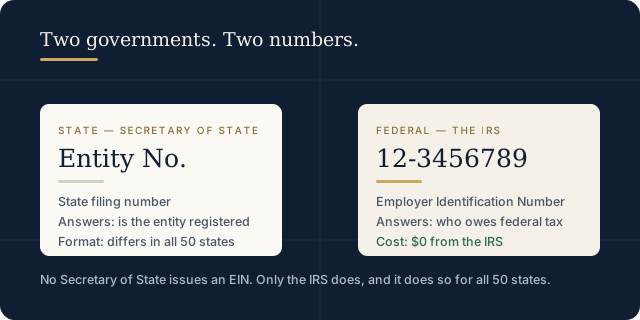
No Secretary of State issues an EIN. An EIN is a federal number, and the IRS is the only office that assigns one, for businesses in all 50 states. A Secretary of State registers the entity and assigns a separate state filing number. Two governments, two numbers, and neither one substitutes for the other.
The search term joins two numbers that never came from the same office. This page separates them, shows where each one is printed, and names the one a bank, a payroll provider, or a platform is asking for.
Does the Secretary of State issue an EIN number?
No. A Secretary of State issues no EIN. The IRS assigns every EIN in the United States, for every business in all 50 states, and charges $0 for it. A Secretary of State registers entities under state law.
The split is one of jurisdiction. An EIN identifies a business to the federal tax system, so a federal agency assigns it. A state filing number identifies a business to one state government, so that state assigns it. No state office holds authority over a federal tax number.
This holds in every state without exception. A company registered in Delaware, in Texas, or in Wyoming receives its EIN from the same federal office as a company registered anywhere else. The state of formation changes nothing about who issues the 9 digits.
The phrase secretary of state ein number describes two real numbers that arrive from two different places. Reading it as one number sends people to the wrong office, and the state office has nothing to give them.
Why do people search for a Secretary of State EIN number?
Formation and the EIN arrive close together. The state assigns a filing number within days of registering the company, so owners holding 2 numbers assume the same office produced both.
Formation services deepen the confusion by bundling both steps into one order. The customer sees a single checkout and receives a single packet, and the packet holds a state document and a federal document that came from separate governments.
State registries add to it through naming. A state calls its number an entity number, a file number, a business ID, or a charter number, and none of those labels announce that the number is not a tax ID.
The practical cost lands at the bank counter. An owner presents a state document when the bank asked for the federal one, the account stalls, and the fix takes days that a correct document would have saved.
What is a state filing number?
A state filing number is the identifier a state assigns to a registered business entity. It proves the company exists on the state register. It carries no role in federal tax filing and no role in IRS records.
The number appears the moment the state accepts the formation documents. Articles of Organization create an LLC, Articles of Incorporation create a corporation, and the state stamps a number onto the approved filing.
Its job is public identification. Every state runs a free online business search, and the filing number pulls the entity record: legal name, status, formation date, registered agent, and filing history.
The format answers to no national standard. One state issues digits only, another mixes letters and digits, and a third encodes the formation year into the string. A number that looks nothing like 9 digits in a 2-and-7 pattern is a state number rather than an EIN.
The obligations attached to it are ongoing. States require a periodic report and a fee to keep the registration active, and a lapsed registration puts the entity out of good standing while the EIN sits untouched.
How does an EIN differ from a state registration number?
An EIN is federal, 9 digits, free from the IRS, and permanent. A state registration number is state-issued, formatted by that state, tied to a filing fee, and replaced with a new number in each state you register in.
| Attribute | EIN | State filing number |
|---|---|---|
| Issuing office | The IRS, a federal agency | A Secretary of State or the state equivalent |
| Level of government | Federal, one system for all 50 states | State, 51 separate systems counting DC |
| Format | 9 digits, printed 2 digits, hyphen, 7 digits | Set by each state, no shared format |
| Common name | EIN, federal tax ID, tax ID number | Entity number, file number, document number, charter number |
| Application form | Form SS-4 | Articles of Organization or Articles of Incorporation |
| Government fee | $0 | Set by each state, charged at formation |
| Confirmation document | IRS CP-575 notice, replaced by a 147C letter | Stamped Articles and a Certificate of Good Standing |
| Renewal | None. Year 2 and every year after costs $0 | Periodic report and fee, set by each state |
| Appears on a federal tax return | Yes | No |
| Publicly searchable | No for a private company | Yes, free on the state registry |
| Changes when you move states | No, the same 9 digits stay with the entity | Yes, each state assigns its own number |
| Requires an SSN to obtain | No, Form SS-4 line 7b accepts Foreign | No |
Sources: IRS Form SS-4 instructions and state business registries, verified July 2026.
The table divides on one line, direction. Everything federal, meaning tax returns, payroll deposits, and information returns, uses the EIN. Everything about the entity's legal existence in a state uses the state number.
The permanence line matters most to growing companies. An LLC formed in Wyoming that registers to do business in California collects a second state number and keeps the same EIN, because the federal taxpayer never changed.
One row surprises people: an EIN is not public for a private company, while state records are. Anyone can pull your entity record from a state registry for $0, and no one can pull your EIN the same way.
Where does your EIN appear?
The EIN appears on the IRS CP-575 notice, on a 147C letter, on every federal tax return the business files, on Form W-9, and on payroll filings. Each shows the same 9 digits.
The CP-575 is the original. The IRS issues it once, at assignment, and it names the entity, states the EIN, and carries the IRS letterhead. Banks treat it as the primary evidence, which is why it is the document worth storing carefully.
The 147C replaces it. The IRS issues no second CP-575, so an owner who lost the original requests a 147C letter by phone. The IRS releases it to the responsible party or another authorized person after verifying that authority.
Filed returns hold the number too. A corporate return, a partnership return, and a payroll return each print the EIN in the header, so a prior-year copy recovers the digits in about 3 minutes when the letter is missing.
Third-party documents echo it rather than prove it. A bank statement, an insurance certificate, or a vendor record shows an EIN that someone typed in, which makes those documents useful for reading the number and weak for proving it.
Where does your state filing number appear?
The state number appears on the stamped Articles the state returned, on a Certificate of Good Standing, on annual report filings, and on the free public entity record in the state's online business search.
The stamped Articles are the state's version of a CP-575. The state returns the approved document with a filing number, a filing date, and an official stamp, and that copy proves formation.
A Certificate of Good Standing goes further than the Articles. It confirms the entity exists today, with reports filed and fees paid, which is why banks and landlords request it rather than the formation document alone.
The public registry is the fastest source. A search by company name returns the filing number with no login and no fee, so a lost state number costs minutes to recover rather than days.
That accessibility is the clean line between the two numbers. A lost state number is a search away. A lost EIN goes through the IRS, because no public registry holds it.
Which number does a bank or a platform actually want?
A bank wants both: the EIN for the federal taxpayer and the state filing document for legal existence. A payment platform wants the EIN alone, matched to the exact legal name held in IRS records.
| Who is asking | Number they want | Document they check |
|---|---|---|
| A bank opening a business account | Both | CP-575 for the EIN, stamped Articles for the state number |
| A payment processor verifying a seller | EIN | The 9-digit EIN matched to the exact legal name |
| A client sending you Form W-9 | EIN | The taxpayer identification number entered in Part I |
| A payroll provider | Both | EIN for federal withholding, state account for state withholding |
| The IRS on any federal filing | EIN | The EIN and the legal name in IRS records |
| The state filing an annual report | State filing number | The entity record on the state business registry |
| A city or county business licence office | Both | Proof of state registration plus the federal EIN |
| A landlord or vendor running due diligence | State filing number | Certificate of Good Standing from the state |
Requirements reflect standard US bank and platform onboarding practice, July 2026.
The word most requesters use is tax ID, and that word means the EIN. A form asking for a tax ID number, a federal tax ID, or a TIN for a business is asking for the same 9 digits in every case.
Name matching decides the outcome more than the number does. An entity written as LLC on the state document and L.L.C. on the IRS record fails verification, and the platform reports a mismatch without saying which side was wrong.
Bring three documents to a bank appointment and the account opens in one visit: the CP-575, the stamped Articles, and a Certificate of Good Standing. Missing the CP-575 is the single most common reason an appointment ends without an account.
Is the office always called the Secretary of State?
No. Business registration sits with a Secretary of State in most states and with a different agency in the rest. None of those offices issues an EIN, whatever the office is named.
| State | Office that registers the business | Issues an EIN |
|---|---|---|
| Delaware | Division of Corporations, Department of State | No |
| Arizona | Arizona Corporation Commission | No |
| Michigan | Department of Licensing and Regulatory Affairs | No |
| Maryland | State Department of Assessments and Taxation | No |
| Virginia | State Corporation Commission | No |
| Hawaii | Department of Commerce and Consumer Affairs | No |
| Wisconsin | Department of Financial Institutions | No |
| New Jersey | Division of Revenue and Enterprise Services | No |
| Utah | Division of Corporations and Commercial Code | No |
| Texas, California, Florida, New York and 30 more | Secretary of State | No |
State agency names verified July 2026. None of the 50 states issues EINs.
The naming difference sends searchers in circles. A business owner in Arizona searching for a Secretary of State EIN finds a Corporation Commission and a different set of forms, then concludes the state has a hidden process. It has none.
The reverse mistake also happens. An owner reaches the correct state office, receives a state number, and files it on a federal form because the office sounded official. Federal systems reject the entry, because no state number exists in IRS records.
The route to a federal number is the same from any state. Form SS-4 goes to the IRS, and the IRS assigns the EIN regardless of which office holds the entity registration.
Which number do you get first?
Register the entity with the state first, then apply for the EIN. Form SS-4 asks for the exact legal name the state approved, and applying before formation risks an EIN attached to a name the state later rejects.
The sequence protects the name match. States refuse duplicate and confusingly similar names, so the name on your application is not final until the state approves it. An EIN issued under an unapproved name creates a mismatch that follows the business into every bank and platform check.
The gap between the two steps is short. The state returns approved Articles, the legal name is fixed, and the SS-4 goes out carrying that exact name, character for character.
One exception runs the other way. A sole proprietor with no state registration applies for an EIN under a personal legal name, because no entity filing exists to wait for.
Fixing a mismatch after the fact costs more than the sequence does. Correcting IRS records means writing to the IRS, and the correspondence timeline exceeds the days that the correct order would have cost.
Can you get an EIN without an SSN?
Yes. Form SS-4 line 7b accepts the entry Foreign for a responsible party who holds no SSN and no ITIN. The IRS assigns the EIN, and no passport upload enters the process at any step.
The no-SSN route runs by fax rather than through the online tool. Entities based in a US state fax the SS-4 to 855-641-6935. Applicants with no US location fax to 855-215-1627. The IRS charges $0 either way.
The IRS international line answers questions on the application at 267-941-1099. That line handles EIN matters for applicants outside the United States, including confirmation of a number already assigned.
State registration follows the same principle. States register entities owned by non-residents, and no Secretary of State asks a foreign owner for an SSN to file Articles.
Have an SSN? Go to irs.gov, apply free, and finish in about 15 minutes. No SSN? The fax route above works, or we prepare and file it for you from $69, double-checked before it reaches the IRS.
What happens if you give the wrong number?
A state filing number entered where an EIN belongs fails verification. Federal systems match against IRS records, the state number exists in none of them, and the form returns an error rather than a partial match.
On a Form W-9 the error moves downstream. The payer reports payments under a number that resolves to nothing, the IRS issues a mismatch notice months later, and backup withholding follows on future payments.
At a bank the failure is immediate and cheaper. The account stalls at the counter, staff name the missing document, and a returning appointment with the CP-575 closes it.
On a platform the number sits in limbo. Verification stays pending, payouts hold, and the seller reads a status message that names no specific field. Replacing the state number with the EIN clears it.
The correction is the same in all three cases. Pull the CP-575, read the 9 digits printed as 2 then 7, and resubmit with the exact legal name the IRS holds.
What else do people ask about state offices and EINs?
+Does the Secretary of State give you an EIN number?
No. A Secretary of State issues no EINs in any of the 50 states. The IRS is the only office that assigns an EIN, and it charges $0. The Secretary of State assigns a separate state filing number when it approves your Articles.
+Is a state filing number the same as an EIN?
No. An EIN carries 9 digits printed as 2 digits, a hyphen, then 7, and identifies your business federally. A state filing number follows whatever format that state chose and identifies the entity on the state register only. Federal forms accept the EIN alone.
+How do I find my state business filing number?
Search the state's free online business registry by company name. The entity record returns the filing number, status, and formation date in about 3 minutes at $0. The same number appears on the stamped Articles the state returned at formation.
+How do I find my EIN if the Secretary of State does not have it?
Check the IRS CP-575 notice first, then any filed federal tax return, which prints the EIN in the header. When both are gone, request a 147C letter from the IRS. Applicants outside the United States reach the IRS at 267-941-1099.
+Do I need a state registration before I apply for an EIN?
Register the entity first when you are forming one. Form SS-4 asks for the exact legal name the state approved, and applying earlier risks a mismatch across every later bank check. A sole proprietor with no entity filing applies under a personal legal name.
+Which number does a bank ask for?
Both. The bank verifies the federal taxpayer through the EIN on the CP-575, and it verifies legal existence through the stamped Articles or a Certificate of Good Standing. Arriving with all 3 documents opens a business account in a single appointment.
+Do I get a new EIN when I register in a second state?
No. The EIN stays with the entity through every state registration, every address change, and every state move. You collect a second state filing number from the new state, while the same 9 digits keep identifying the business to the IRS.
+Can I get an EIN without an SSN?
Yes. Form SS-4 line 7b accepts the entry Foreign for a responsible party with no SSN or ITIN. US-based entities fax the form to 855-641-6935 and applicants outside the country fax to 855-215-1627. The IRS charges $0 and asks for no passport.
+Does an EIN or a state number expire?
An EIN never expires and costs $0 in year 2 and every year after. A state registration requires a periodic report and a fee set by that state, and skipping it puts the entity out of good standing while the EIN stays valid.
+Is my EIN public like my state filing number?
No for a private company. State entity records are public and searchable for free across all 50 states, which is why a lost state number takes under 3 minutes to recover. A private company EIN appears in no public database, so recovery runs through the IRS 147C letter route, faxed during the call on request, otherwise mailed.
This page states IRS and state registration procedures current as of July 2026. It is not legal or tax advice. ein-number.com is not affiliated with the IRS or any state agency.
State registration done, federal number still missing?
The state has given you everything it issues. The EIN comes from the IRS on Form SS-4, and the IRS charges $0. Have an SSN? Apply free at irs.gov in about 15 minutes. No SSN? We prepare the form and double-check it before submission: $69 Standard, filed by fax within 8 business days and 2–3 weeks total, or $99 Fast, filed within 24 hours with the IRS call included and 7 business days total. If we make an error, full refund, no conditions.
No SSN. No passport upload. · EIN filing, accuracy guaranteed
Which primary sources back this page?
Every fee, deadline, form number and phone line above is taken from the 3 official documents below. No third-party blog is cited.